Critical Race Theory: A Case Study in Institutional Capture
Of the campaigns described above, one demands close examination, because it is the most fully developed, the most consequential, and the most widely argued about by people who have read none of its literature. It also has the clearest before-and-after: a standard that worked, an anomaly it failed to explain, and a replacement that cannot be checked. What follows is the sequence.
The Standard
The American argument about race has never been civil and was never conducted in good faith by all parties. It could not have been. A people who had declared all men created equal while holding a fifth of its population as property was bound to fall into disarray.
But observe what the Founders did. By making the assertion in their foremost document, they produced something more durable than agreement and more effective than a rule: a principle whose logic could not be contained once it had been stated. Equality before the law. Rights inhering in persons rather than granted by station. A criterion that applied to everyone, even to the extent that it indicted the men who wrote it, and went on indicting them and their heirs for two hundred years.
That is what an objective standard is — a measure that binds everyone — and the entire moral achievement of the following two centuries was accomplished by wielding it.
The lineage is unbroken. The abolitionists argued from the Declaration, not against it. Frederick Douglass, who asked in 1852 what the Fourth of July meant to the slave, did not answer that the founding principle was a fraud; he answered that it was a promise being broken, which is an infinitely more powerful charge. Lincoln gave “All honor to Jefferson,” in a 1859 letter, acknowledging that it was he who introduced “into a merely revolutionary document, an abstract truth, applicable to all men and all times, and so to embalm it there, that to-day, and in all coming days, it shall be a rebuke and a stumbling-block to the very harbingers of re-appearing tyranny and oppression.” And a century later Martin Luther King Jr., on the steps of the Lincoln Memorial in 1963, called the founding documents a promissory note to which every American was heir, and asked the nation to honor what it had written down — then named the standard in the sentence more Americans can recite than any other spoken in the twentieth century: “I have a dream that my four little children will one day live in a nation where they will not be judged by the color of their skin but by the content of their character.”
Every one of those men could have argued with the Postmodernists that the principle was a mask for power, and that the neutrality of the law was the instrument of their subjection. None of them did. Because the standard was the most effective weapon available to them, and it was effective for exactly one reason: It bound the people holding the whip.
And it delivered. Abolition. The Thirteenth, Fourteenth, and Fifteenth Amendments. Brown in 1954. The Civil Rights Act of 1964. The Voting Rights Act the following year. After the Declaration, and largely because of it, an institution which had been the foundation of civilization from time immemorial had begun to be dismantled. It was not a rapid process, even when considering the grand scale of human history. But it was consistent and steady and, by the mid-20th century, the legal architecture of American hierarchy — built over three centuries — was corrected by appeal to a standard that the architects themselves had signed.
Figures such as William Hastie and Thurgood Marshall, who led the way in black legal advocacy, expressed the consensus attitude toward the mid-century civil rights achievements: Once black Americans had full citizenship, they believed, they would have reached the promised land. The standard authorized the belief. The amendments had been written to make it reality.
The Anomaly
But in the 1970s, something changed.
The formal machinery of discrimination was gone. The bad statutes were all struck, the tests abolished, the doors opened by law. But on measure after measure — employment, household wealth, family structure, incarceration — the gaps persisted, and several widened.
It is difficult now to recover how disorienting that must have been for people who had believed, with excellent reason, that the barrier had always been the unjust laws. The reforms had been fought for across a century, at enormous cost, against violent resistance. They had been won. And the promised result had not arrived.
It was hard to accept the notion that these things would just take time. It had already been over a century since the Civil War and Juneteenth. Were they to believe it would take another hundred years before black people could achieve true equality? The argument was made that something was wrong with the people the reforms were meant to help — which had been the segregationist’s argument for decades and was even less acceptable by any serious onlooker. Out of the wreckage of the New Left, a third option arose: The standard itself was the problem.
Herbert Marcuse had already supplied the logic, in his 1965 essay Repressive Tolerance. Tolerance administered inside an unequal society is not neutral. It serves the existing distribution of power. The appearance of even-handedness is the mechanism by which inequality reproduces itself. Applied to law rather than to speech, the conclusion is immediate and total: Equality before the law does not fail to correct hierarchy. It maintains it, and fairness is the culprit.
Stokely Carmichael and Charles Hamilton said the same thing in the language of politics, in Black Power in 1967, and gave the condition its name. Individual racism was an act you could charge a man with. Institutional racism was what remained when the act had been forbidden and the result had not changed — less overt, harder to name, originating in “the operation of established and respected forces in the society.” The problem was no longer a bad law. A bad law can be pointed at, repealed, and disobeyed. The problem was the system of laws, and behind the system the culture that kept producing the old result through neutral-looking rules. Once that is granted, repeal has no stopping place. The evidence that the institution is guilty is precisely the disparity the repeal did not erase.
Civil rights lawyer Derrick Bell had come to the same conclusion after spending the 1960s in the South working for the NAACP Legal Defense Fund. Despite the momentous legal victories, Bell surmised, blacks were still facing discrimination throughout society because racism had been baked into the culture. Bell later recalled the moment when it all became clear to him in what he said was a “courtroom epiphany”.
The judge asked the newly minted citizens to gather around the bench to be sworn in, then welcomed them to the country in tones of sweetness and warmth that were the Dr. Jekyll opposite of the Mr. Hyde treatment he’d been giving my clients for seeking the relief to which the Supreme Court had said they were entitled a decade earlier.
But that wasn’t what surprised me. What froze me in my seat, dumbfounded, was this realization: the moment these people became citizens, their whiteness made them more acceptable to this country, more a welcome part of it, than the black people I was representing would likely ever be.
The realization pushed me to a moment of existential doubt. What was the point? Why was I trying to get children admitted to schools where they were not wanted, and where — unless they were exceptional — they would probably fare poorly? Chances were good that they would drop out, or be expelled for responding with anger or violence to the hostile treatment they were sure to receive.
As Bell said in a later work, “It appears that my worst fears have been realized: we have made progress in everything yet nothing has changed.”
Bell began to question whether the civil rights approach was the right path after all. He told fellow activist Winson Hudson, whom he had advised on integration, that he had wondered whether he had pushed her in the right direction. She wondered too. From their vantage in the 1970s, the standard set by the Founding and which every abolitionist and civil rights activist had relied upon, had not in the end achieved what it promised. Rather, it had come to look less like a principle and more like a negotiation. He was not reconciled to it. He was finished with it. The regime of legal colorblindness, as he came to call it, was not a project to be finished. It was a trick.
Harvard Law School hired Bell in 1969; two years later he was its first tenured black professor, and from that office he went looking for a more radical account of why civil rights had not resulted in equality. As he found, the materials were already on the shelf. Antonio Gramsci had seen the importance of cultural institutions just as Carmichael and Hamilton had, and had sketched out a solution, a war of position—not the seizure of the state in a weekend, but the slow occupation of the schools, the courts, the professions, the language in which a people tells itself what is normal. Paulo Freire, in his Pedagogy of the Oppressed, had supplied the educational paradigm for this transformation: shifting away from traditional objective instruction—where a teacher imparts established knowledge to a student—toward a practice of critical consciousness-raising, in which the oppressed learn to name their own systemic oppression and treat that very act of naming as the primary instrument of liberation. For Bell, traditional civil rights efforts had reached their limit, but the radical frameworks of Gramsci and Freire offered a transformative path forward through cultural and educational institutions.
In 1973 Bell published Race, Racism, and American Law, a casebook that reread the great civil-rights victories, not as vindications of the Founding principle, but as motivated concessions designed to benefit white interests. In 1980 he stated the rule that became the field’s foundation. In his essay Brown v. Board of Education and the Interest-Convergence Dilemma he argued that the Court had not struck segregation because it had been brought, at last, to see the wrong in it. Desegregation had converged, at that moment, with the Cold War interests of the American state. The historical point is not empty. The Justice Department’s own brief in Brown made the foreign-policy argument in so many words, and later scholarship documented it.
Bell formulated it into a sociological law. White support for black progress occurs when, and only when, it serves white interests. Opposition proves racism. But support proves self-interest, which also proves racism. In the end, no course could vindicate the powers that be because any possible behavior had already been shown to be sinister.
From that point the fight could not be conducted on the grounds that the Founders had laid out. It was going to be conducted on the grounds that the Postmodernists had established: that truth claims are plays for power and the only way to prevail against a play for power is to take the power.
In July 1989, legal scholar and activist Kimberlé Crenshaw and a small group of legal academics — Neil Gotanda, Gary Peller, Kendall Thomas — convened a workshop in Madison, Wisconsin, and called the work ‘Critical Race Theory’. In the introduction to the anthology that later collected the movement’s founding writings, the editors were plain about the genealogy. Critical Legal Studies was, as the theorists put it, “organized by a collection of neo-Marxist intellectuals, former New Left activists, ex-counter-culturalists”. They were equally plain about the targets. The movement’s own foundational documents name them without reservations: color-blindness, formal legal equality, and integrationism, as well as equality theory, legal reasoning, Enlightenment rationalism, and the neutral principles of constitutional law. And it names the aim in the old Marxist register. The desire was “not merely to understand the vexed bond between law and racial power but to change it.”
Put those two commitments together and a method follows by entailment rather than by design. If winning an argument on neutral ground has been impeached on the ground that no neutral ground exists, then argument is no longer available. What remains is narrative, and narrative is controlled by occupying the places it is repeated. The school. The court. The newsroom. The hiring committee. Nobody had to circulate a memorandum. Gramsci and Freire had adumbrated the approach; it was left to the Critical Race Theorists to employ it.
The Method
The first thing to understand about the method is that it did not begin with a new theory of race. It began with a new theory of knowledge.
The traditional civil-rights argument had been over the proper application of a universal principle. The law said one thing; the country did another. The remedy was to expose the contradiction and compel the country to honor its own commitments. The argument relied upon an objective standard — a principle that could be applied to a particular case, tested against the evidence, and used to determine whether an injustice had occurred.
The new argument was different. It questioned whether such a standard could exist in the first place. If the law was written by people who held power, if the institutions that interpreted it were staffed by people who held power, and if the intellectual traditions used to justify it had been developed by people who held power, then what reason was there to believe that the system’s professed neutrality was anything more than a particularly effective expression of that power?
This was not an incidental criticism. It changed the nature of the enterprise. A dispute that had once been conducted over whether a particular law violated a universal principle would now be conducted over whether the principle itself was legitimate. And if the principle was illegitimate, then the evidence and reasoning used to defend it were suspect before the argument even began.
Gary Peller, in his essay “Race-Consciousness”, made the epistemological challenge explicit. “Objective reason or knowledge could not exist,” he argued, “because one’s position in the social structure of race relations influenced what one would call ‘knowledge’ or ‘rationality.’ ” Knowledge itself was a function of the ability of the powerful to impose their views and to distinguish between knowledge and myth, reason and emotion, objectivity and subjectivity. As Peller put it, “Culture precedes epistemology.”
This is a remarkable proposition. It does not merely say that people in positions of power sometimes use knowledge to defend their interests. That is an ordinary observation about human behavior. It says that the very categories by which we distinguish knowledge from myth, reason from emotion, and the objective from the subjective are themselves products of power structures.
The distinction matters. The first proposition invites investigation. The second places the investigator under suspicion.
If a legal scholar argues that a particular constitutional interpretation is mistaken, the traditional response is to examine the text, the precedent, the history, and the reasoning. But if the standards of legal reasoning are themselves products of racial power, then an appeal to those standards is no longer an answer. It is evidence of the problem. The argument has been moved from the question of whether a proposition is true to the question of whose interests are served by believing it.
The shift is especially clear in the development of ‘counterstorytelling’. Richard Delgado’s 1989 essay, “Storytelling for Oppositionists and Others”, argued that stories are not merely decorative illustrations of an argument. They are among the means by which people construct social reality. The stories a society tells about itself determine which experiences are remembered, which are forgotten, and which interpretations become conventional wisdom. Counterstories, in turn, can challenge those inherited accounts and make visible experiences that the dominant narrative has excluded.
There is something plainly valuable here. One who has been excluded from an institution may know things about its operation that its administrators do not. A legal doctrine that appears neutral in the abstract may produce consequences that become apparent only when examined from the perspective of those subject to it. The testimony of people who have experienced discrimination is evidence, and any serious inquiry ought to be willing to hear it.
But there is a difference between making room for previously excluded evidence and changing the rules by which evidence is evaluated. A story can reveal a fact that an established account has overlooked. It can also be mistaken, incomplete, or unrepresentative. It can establish what a person experienced without necessarily establishing why it happened, whether it was typical, or what policy would correct it. The fact that an account is sincerely held does not make every interpretation drawn from it true.
The difficulty arises when the distinction disappears.
Charles Lawrence III, in “The Word and the River”, described a pedagogy that privileged the perspectives of outsiders and sought to elevate the victim’s perspective over that of the perpetrator. The objective was not simply to add more voices to the discussion. It was to change the position from which the discussion was conducted. The measure of an activist philosophy, Lawrence suggested, was not whether it approached the truth but “the degree to which the effort serves the cause of liberation.”
That sentence deserves to be read carefully. It is not necessarily an argument that truth is irrelevant. It is, however, a declaration that the success of an intellectual undertaking may be measured by its political usefulness rather than its correspondence with an independently established reality. The distinction between the two is precisely what the older epistemology was designed to preserve.
Lawrence’s own story provides the quintessential exhibit: A colleague approached him on a reading he had assigned. “I am offended,” she said, “therefore, these materials are offensive.” The first half of the sentence is beyond dispute. No one can reasonably demand that another person prove the existence of his own subjective experience. But the second half is a different proposition entirely. Whether the material is objectively offensive, whether it is racist, whether it should be removed from a curriculum, and whether others should be prohibited from discussing it are questions that require further argument.
If the first proposition is permitted to establish the second, then the subjective experience has become the adjudicating authority. And if the experience cannot be challenged without appearing to deny the person who reports it, the argument has acquired a peculiar immunity.
The very notion of objectivity became suspect because it was associated with the dominant culture. Subjectivity became valuable because it was associated with the marginalized. The old hierarchy of evidence was inverted, but the need for a hierarchy of evidence did not disappear. It was simply replaced with a different one.
And once the authority to determine what is true is transferred from a common standard to a person’s social position, the next question becomes unavoidable: How do we know which position is authoritative? Who is the victim? Who is the oppressor? What counts as liberation? What is the measure of justice? If those questions cannot be answered by an independent standard, then they must be answered by the theorists themselves.
The Redefinition
As with all Postmodernist campaigns, the first step was redefinition and the first and most consequential redefinition concerned the word ‘racism’.
In ordinary usage, ‘racism’ had generally described an attitude or practice — the belief that race determined a person’s character or worth, or the treatment of an individual differently because of his race. The civil-rights movement had been organized against precisely this kind of discrimination. Its demand was that race should not determine a person’s legal status, rights, or opportunities.
But, as the Critical Race Theorists had concluded, the effort to remove individual prejudice and discriminatory conduct could not alter the disparities still seen across America. If a society prohibited racial discrimination and yet racial disparities persisted, then the definition itself appeared inadequate.
The answer was to expand the concept. ‘Racism’ would no longer be understood primarily as an individual’s attitude or conduct. It could also describe the operation of institutions, policies, cultural norms, and social structures, even in the absence of an identifiable person acting with racial animus.
The intellectual development of this idea predates CRT. In 1967, Stokely Carmichael and Charles V. Hamilton popularized the distinction between individual and institutional racism in Black Power. They argued that racial oppression could be maintained through established institutional practices without requiring an explicitly prejudiced individual to administer them. Then, in 1970 Patricia Bidol-Padva published a curriculum guide in which racism was redefined as ‘prejudice plus power’, essentially detaching the concept from individual belief and behavior. Finally, Judith Katz’s White Awareness carried the formula into institutional training a few years later. The effect was subtle but crucial.
In its established meaning, the term ‘racist’ names a person who holds some races inherently superior, or who treats a person worse because of his race. It applies to some people and not to others. It can be defeated by a counterexample. And it carries as much moral weight as any word in the language. Under the new definition it names a structure. To participate in, or to benefit from, whether it is intentional or not, a system that distributes advantage by race at all is to be guilty. The new sense covers the entire advantaged group. It admits no counterexample, because a counterexample would be personal, and the new sense is not about persons. And, yet, it inherits the old word’s moral charge without a second take.
The distinction can be useful. It becomes dangerous when the two meanings are allowed to operate interchangeably.
A person could now be accused of racism without having expressed racial prejudice, discriminated against anyone, or even intended a discriminatory result. A policy could be called racist because it produced a disparity, even when its rules were facially neutral and its authors had no discriminatory intent. The question was no longer simply whether a person had treated another person unjustly. It was whether the person’s conduct, or the policy he supported, contributed to a larger pattern of unequal outcomes.
And that was the power of the maneuver. The scope of the accusation had changed, but the moral force remained. This is Shackelian Humpty Dumptying in its most consequential form. The word retains its familiar emotional charge while acquiring a new operative meaning. The listener hears the old accusation and assumes the old definition; the speaker may be employing the new one. The result is not confusion over terminology as might be expected. It is a change in the leverage of the most consequential social debate of the 20th century.
The redefinition does not itself establish that the new proposition is wrong. It does something more subtle: It makes the disagreement difficult to recognize. Two people can use the same word while arguing for fundamentally different principles. One believes justice requires the same rule for everyone. The other believes justice requires different interventions to correct unequal outcomes. Each can accuse the other of opposing equality, because each is using a different definition of what equality requires.
The Equivocating Fulcrum
Kimberlé Crenshaw was unusually candid about the intellectual lineage of the movement. In her introduction to the foundational CRT literature, she described the role of race in critical legal scholarship in terms that deliberately recalled Marxism:
“By legitimizing the use of race as a theoretical fulcrum and focus in legal scholarship,” the editors wrote, “so-called racialist accounts of racism and the law grounded the subsequent development of Critical Race Theory in much the same way that Marxism’s introduction of class structure and struggle into classical political economy grounded subsequent critiques of hierarchy and social power.”
The analogy is revealing. Marxism had taken class, previously treated as one variable among many in political economy, and made it the organizing principle through which the entire social order could be interpreted. CRT would do something similar with race. The concept would become not merely a characteristic of individuals or a subject of legal protection, but a central organizing principle for understanding institutions, history, and power.
Whence the equivocating fulcrum. Using the new definition of ‘racism’, the practitioners of Critical Race Theory were able to lift the weight of the entire argument. If ‘racism’ is ‘prejudice plus power’, the necessary conclusion is that all white people must be racist, regardless of what they believe or do because the white race is the one in power. By the same token, no minority can be racist. The fulcrum is breathtaking in its simplicity: It is a tautology that no one can disagree on using the structural reading, but the gravest of accusations of personal evil on the ordinary one. Usage does not mark which meaning is intended. And that’s the point. The charge travels with whichever reading is useful, and the speaker who is challenged on one produces the other.
The distinction is particularly clear in Ibram X. Kendi’s How to Be an Antiracist. Kendi defines a racist policy as “any measure that produces or sustains racial inequity between racial groups,” and an antiracist policy as one that produces or sustains racial equity. He goes further: “There is no such thing as a nonracist or race-neutral policy.” Every policy, in his account, either produces or sustains racial inequity or produces or sustains racial equity.
The argument has not simply proposed a different policy. It has changed the meaning of the moral category by which the policy is judged.
And this is where the rhetorical advantage becomes apparent. Who supports racism? No one, at least not openly. Who opposes equality? No one, at least not in principle. Who wants injustice? No one. The moral authority of these words is nearly universal. But once their meanings have been altered, the person who continues to use the older definitions can be made to appear opposed to the values themselves. The opponent is no longer merely mistaken about the policy. He is opposing justice.
Troll’s Truisms and the Moral Shield
A further protection comes from propositions that no reasonable person would dispute.
Racism is bad. People should be treated with dignity. Racial groups are equal in human worth. Discrimination is wrong. These are not controversial propositions. They are the moral foundations of the civil-rights tradition.
But their very obviousness makes them useful rhetorical instruments. A speaker can begin with an indisputable moral statement and then attach to it a much more controversial claim. The audience is left with the impression that rejecting the second claim would require rejecting the first.
The MTV “End Racism” campaign of the 1990s illustrates the broad appeal of this kind of moral language. Its message was simple, direct, and difficult to oppose. The later slogan “Black Lives Matter” achieved an even greater cultural reach. Taken literally, the proposition is not a political controversy. Black lives do matter. The question is what additional political, legal, and institutional claims are being advanced under the protection of that proposition.
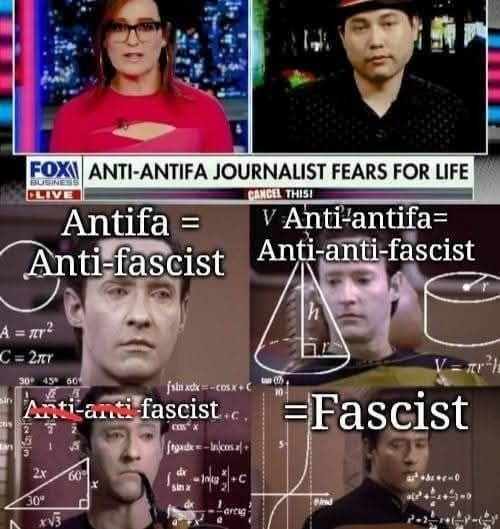
This is the distinction between the truism and the argument. A person may affirm the equal dignity of black Americans while disagreeing with a particular account of systemic racism, a particular policy proposal, or a particular interpretation of a contemporary event. The slogan itself does not settle those disputes.
The rhetorical maneuver occurs when the moral truth is treated as though it establishes the policy conclusion. If you disagree with the proposed policy, are you disagreeing that black lives matter? If you question the interpretation of a disparity, are you denying that racism exists? If you object to a particular form of antiracism, are you defending racism?
The truism becomes a shield around the argument. The opponent is compelled to spend his time proving his moral credentials before he can begin to address the substance of the disagreement.
This is not unique to racial politics. Every political movement has its own moral truisms. No one supports cruelty, injustice, or oppression. The danger arises when the moral authority of those words is used to foreclose debate over what they mean in a particular case.
The Motte and the Bailey
With the fulcrum secured in place, the Critical Race Theorists expanded the argument to an entire doctrine, witnessed by the language of multiculturalism and later diversity, equity, and inclusion (DEI) efforts. The basis for it all is of course unassailable—who could object to a society in which people from different backgrounds are welcomed, treated fairly, and given the opportunity to participate? This motte is an heir of the Founding principles of freedom for all and equality under the law.
But the policy prescriptions attached to these words were considerably more demanding. Diversity was used to push for not merely the removal of barriers but the achievement of specified demographic representation. Inclusion may mean not merely equal access but the redesign of institutional practices to produce particular outcomes. Equity may require differential treatment, redistribution, or the abandonment of ostensibly neutral selection criteria.
Doubtless, these are legitimate subjects for debate. They are not entailed by the modest proposition that people should be treated fairly. The maneuver works when the modest proposition is used to shelter the more controversial one. A person who objects to a demographic quota, a race-conscious hiring rule, or a policy that gives preference to one group may find himself asked whether he opposes diversity. But he has not necessarily opposed diversity. He may simply reject the proposition that diversity requires a particular distribution of outcomes or that the state should treat individuals differently according to race. The question has shifted without the shift being acknowledged.
The same pattern appears in the relationship between equality and equity. The motte is that everyone should have a fair opportunity. The bailey is that institutions must produce equal outcomes among racial groups. When challenged on the latter, the advocate can retreat to the former: ‘Surely we all want fairness.’ Once the challenge subsides, the argument returns to the more ambitious prescription.
We recently witnessed an eye-popping application of the motte and bailey as conservative activists like Christopher Rufo reported the widespread use of CRT in the education system and called for its removal from the curricula. The common retort was that the critics didn’t want history classes to talk about slavery. Of course, no one made that argument. That was the motte and completely impenetrable. What the critics were protesting was the bailey, training teachers that “all whites are intrinsically oppressors” and “white teachers are guilty of spirit murdering black children”.
In America’s Cultural Revolution, Rufo describes the constitutional dimension of this transformation. The critical theorists did not merely seek to enforce the existing understanding of individual rights and equal protection, a traditionally American motte. They proposed a different understanding of the Fourteenth Amendment, one that moved from negative rights—protection against state intrusion—toward positive rights, or entitlements to state action. In this conception, the state would not simply refrain from discriminating. It would be expected to intervene to correct racial disparities.
The distinction is fundamental. A constitutional order built around equal protection asks the state to treat citizens according to the same legal standard. A system of positive racial entitlements asks the state to take action on behalf of groups, potentially treating individuals differently in order to achieve a particular distribution of benefits.
The second proposal may be defended on its own terms. But it is not simply a more vigorous application of the first. It represents a different theory of government and a different understanding of what equality requires.
The motte-and-bailey allows the distinction to disappear. The constitutional language of equal protection remains available as the respectable, familiar defense, while the proposed transformation of the state proceeds under its moral cover.
The Postmodernist Fox-Trot
The postmodernist approach creates a particular difficulty for any shared standard of right and wrong. If meaning is largely a product of social position, and the authority to interpret an encounter rests chiefly with the person who experiences it, then the possibility of a common standard becomes increasingly elusive. The concept of ‘microaggressions’ provides a useful illustration of this problem—and of what Nicholas Shackel calls the Postmodernist Fox-trot. The term was coined by psychiatrist Chester Pierce in 1970 to describe subtle insults and dismissals directed at black Americans, then revived and expanded by psychologist Derald Wing Sue in 2007. The concept recognizes that prejudice need not be deliberate or overt: People may communicate negative assumptions through seemingly innocuous comments or behaviors without intending offense or even recognizing their potential impact.
There is an understandable insight here. Prejudice does not always announce itself with a slur or an act of deliberate discrimination. A careless remark can hurt even when no injury was intended. The difficulty begins when the concept moves from describing subtle prejudice to providing a framework for identifying it and punishing its perpetrators. What makes a remark a microaggression may depend less on the words themselves than on the meaning attributed to them by the recipient. A question about someone’s background might be ordinary curiosity in one conversation and an expression of racial othering in another. A compliment might be received as sincere appreciation or interpreted as a racial stereotype. Intention becomes secondary, subjective impact central. And disagreement with the recipient’s interpretation can itself be classified as another microaggression: a denial of lived experience, a refusal to acknowledge privilege, or an attempt to silence the person who has been harmed.
Critics have questioned whether microaggression theory has developed a sufficiently reliable scientific basis to support the conclusions often drawn from it. Psychologist Scott Lilienfeld, for example, identified problems involving subjective interpretation, inconsistent definitions, limited experimental testing, and reliance on anecdotal evidence. These criticisms do not establish that subtle prejudice never occurs; they raise the more basic question of how we can reliably determine when it has. If the recipient’s interpretation is treated as the principal evidence, while the speaker’s intentions or alternative explanations cannot meaningfully challenge it, the concept risks becoming self-confirming. The experience establishes the offense; disagreement with that experience becomes evidence of the offender’s failure to understand it.
This is where the dance begins. To question whether a remark was really racist risks being accused of invalidating someone’s experience. To ask for evidence risks being accused of demanding that the injured party prove the injury. Even an apology may not settle the matter if it fails to acknowledge the broader diagnosis of systemic prejudice. The accused is left trying to demonstrate an absence of bias that may be impossible to establish, while the aggrieved party occupies the stronger moral position. Sociologists Bradley Campbell and Jason Manning have described a related development as a culture of victimhood, in which perceived offenses are increasingly taken to third parties for public recognition and validation. The concern is not that genuine injuries should be ignored, but that a system organized around the recognition of grievance can reward its accumulation and escalation.
John McWhorter offers a particularly pointed illustration in Woke Racism, where he identifies ten tenets of what he calls Third Wave Antiracism. His examples reveal a system in which nearly every possible action can be construed as evidence of racial wrongdoing: white people may be criticized for moving away from black neighborhoods, but also for moving into them; condemned for dating only within their own race, but accused of exoticizing someone when they date across racial lines. McWhorter’s point is not that every concern behind these propositions is frivolous, but that the demands can become contradictory and difficult to satisfy. The rules do not establish a coherent standard of conduct so much as a shifting field of moral hazards.
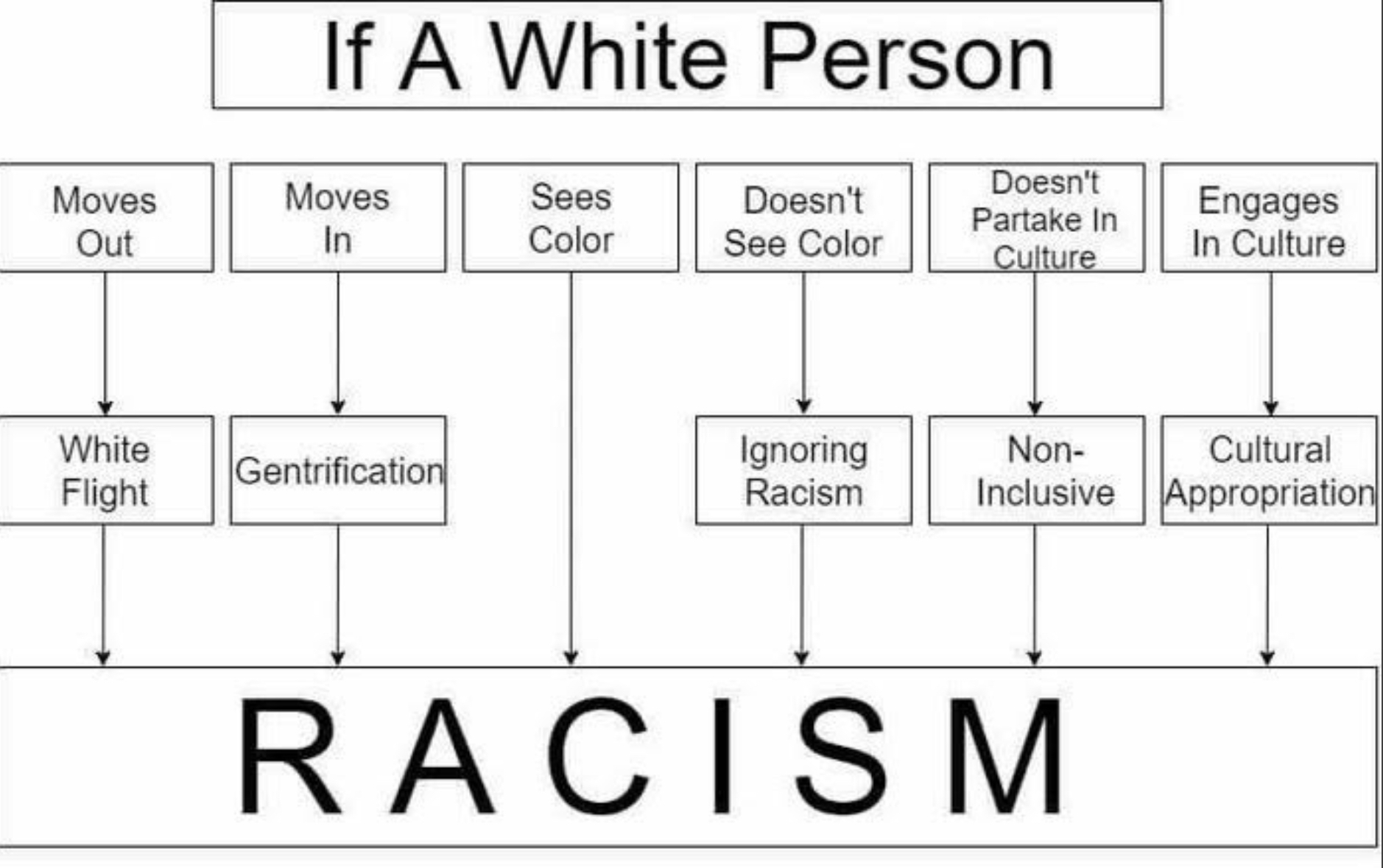
This is the Postmodernist Fox-trot in its clearest form. The accused takes one step toward satisfying the charge, only to discover that the ground has moved. Defending one’s intentions becomes evidence of denying impact; acknowledging impact is insufficient without accepting the larger diagnosis; asking what evidence would settle the question is treated as an attempt to impose an inappropriate standard of proof. The critic cannot appeal to a neutral standard outside the system because neutrality itself may be dismissed as an instrument of power. There is no mutually accepted referee, no stable test, and no clear point at which the matter can be resolved. A concept intended to make subtle prejudice visible can thus make ordinary social interaction increasingly fraught, encouraging people to scrutinize every exchange for hidden meanings and to interpret ambiguity as evidence of bias. The epistemological problem is not simply whether someone has been offended, but who has the authority to determine what happened, what it meant, and whether any competing interpretation is allowed to stand.
Rankly Relativising the Standards
The final maneuver is to relativize the standards by which the dispute might otherwise be resolved.
If a critic asks for evidence, the demand for evidence can be characterized as an expression of a particular epistemology. If he appeals to neutrality, neutrality can be described as a fiction that protects existing power. If he invokes merit, merit can be treated as a cultural construct that reproduces historical advantage. If he asks for a consistent rule, consistency itself can be questioned as a product of the dominant intellectual tradition.
The result is that the standards of judgment become part of the dispute. The argument can no longer be settled by appealing to evidence, because the legitimacy of the evidentiary standard is itself contested. It cannot be settled by appealing to reason, because reason has been associated with a particular social position. It cannot be settled by appealing to neutrality, because neutrality is understood as the mask through which power operates.
The Smithsonian’s 2020 “Talking About Race” portal, for example, circulated a list of characteristics associated with “whiteness and white culture” that included objective thinking, an emphasis on the scientific method, cause-and-effect reasoning, hard work, and delayed gratification. The chart was derived in part from Judith Katz’s 1978 White Awareness and served as the opposite bookend of the CRT movement, demonstrating the extraordinary distance the argument had traveled. Habits of reasoning that had once been regarded as basic instruments of inquiry could now be presented as culturally particular characteristics of a dominant racial group.
The difficulty is not that the scientific method has never been used by powerful institutions to justify their interests. Nor is it that the history of science is free from prejudice. It is that the scientific method is valuable precisely because it offers procedures by which claims can be tested independently of the identity of the person making them. A hypothesis does not become true because it is advanced by a member of a marginalized group, nor false because it is advanced by someone from a dominant group.
To describe such procedures as the property of one race is to confuse the history of an institution with the validity of its methods.
The same question arises in the debate over decolonization. There is a serious and worthwhile inquiry into the ways in which colonial power shaped universities, curricula, and the production of knowledge. But the term can also be used to suggest that the very standards by which scholarship is evaluated are colonial impositions. If the criteria of evidence, argument, and logical consistency are themselves treated as expressions of domination, then the critic has no common ground on which to make his case.
The problem is not that Western intellectual traditions should be immune from criticism. They should not be. The problem is that criticism requires objective standards. A claim that a particular tradition has excluded certain voices must itself be supported by evidence. A claim that a method is biased must be demonstrated by showing how it produces unreliable or unjust results. The argument cannot simply declare the standards illegitimate and then expect its own conclusions to be accepted.
This is the final stage of the epistemological dissolution. The framework does not merely dispute the conclusions reached by the old standards. It challenges the legitimacy of the standards themselves, while offering no stable alternative by which its own conclusions can be tested.
Unimpeachable
There were, of course, critics. They came from different political traditions and disagreed with one another about the nature of the problem. Some accepted the need for race-conscious remedies but rejected the more radical epistemological claims. Others questioned the centrality of race as an explanatory category. Still others argued that the movement’s intellectual premises would undermine the very civil-rights principles it sought to advance.
William Julius Wilson was one of the most important voices in this debate. In The Declining Significance of Race (1978), Wilson argued that class and economic structure had become increasingly important in determining the life chances of black Americans, particularly as the black middle class gained access to opportunities that had previously been denied. He did not argue that racism had disappeared, nor did he reject affirmative action. He argued that race-specific remedies alone could not address the conditions of the black urban poor, and that broad economic policies—full employment, better schools, universal health care, and other measures—could be essential to improving their circumstances.
His argument was controversial because it challenged the assumption that race should remain the primary organizing category for understanding every dimension of black disadvantage. It also suggested that some policies intended to address racial inequality might be less effective than policies aimed at the economic conditions producing poverty.
Wilson’s position was not that race no longer mattered. It was that the relative significance of race and class had changed, and that public policy needed to account for that change. It was a serious alternative explanation, advanced by a prominent black sociologist, and it deserved to be judged on its evidence and merits.
But the emerging intellectual climate made such arguments difficult. A framework that understood race as the central organizing principle of American society could interpret a shift toward class analysis as a retreat from the racial question. Wilson’s argument could be treated not merely as an alternative explanation but as a political intervention that weakened the struggle against racism.
When the American Sociological Association gave Wilson’s book its Spivack Award, the Association of Black Sociologists protested. The core of their objection was not that Wilson’s data were wrong. It was that his conclusions would be useful to the wrong people — that they would hand ammunition to anyone seeking to dismantle race-conscious programs.
Sit with that. It is the entire subsequent history in a single committee. A claim was adjudicated by its likely consequences rather than by its accuracy. The question was not “Is this true?” The question was “Who benefits if it is?” Among professional sociologists, in public, in 1978.
Eleven years after Wilson, Randall Kennedy — Harvard Law, also black, also not a conservative — published an essay in The Harvard Law Review that did the thing the new discipline had made beyond the pale. He asked whether its central claims had been established. Kennedy examined arguments that scholars of color were systematically excluded or undervalued in legal scholarship, and questioned whether the evidence supported the claims being made. He also challenged the suggestion that minority scholars should be granted a different intellectual standing because of their racial identity, or that their work possessed a distinctive authority by virtue of their experience.
Kennedy did not deny that racial exclusion existed in legal academia. He argued that claims of exclusion and intellectual distinctiveness required evidence, and that the identity of the person making an argument could not substitute for the quality of the argument itself.
The political difficulty was apparent. A critique of the framework could be used by people who opposed racial equality. Kennedy himself acknowledged the danger that his work might be appropriated for purposes he did not support. But that possibility cannot settle the question of whether his argument is correct. If an argument is rejected because it might benefit the wrong people, then the standard of judgment has changed. The question is no longer whether the claim is true. It is whether accepting it would advance the cause.
This is the most consequential form of capture. It is not simply that a critic is accused of racism, or that his credentials are questioned, or that his argument is deemed insufficiently sensitive. It is that the validity of the argument is subordinated to its political consequences. The evidence may be accurate, the reasoning sound, and the conclusion defensible; but if the conclusion is thought to benefit the wrong people, it can be rejected on that basis alone.
At that point, the theory has acquired a protection against ordinary criticism. It can determine in advance which conclusions are acceptable and which are suspect, not by examining their evidentiary support but by evaluating their political destination.
Henry Louis Gates Jr. and other black intellectuals warned that a politics organized around racial identity and the policing of ideological boundaries could produce a new form of orthodoxy. The concern was not that people would be prevented from discussing race. It was that they would be permitted to discuss it only within an increasingly narrow set of approved assumptions. The result would be an intellectual environment in which dissent was not treated as a necessary part of inquiry but as evidence of moral or political failure.
The irony is difficult to miss. The civil-rights tradition had demanded that institutions abandon racial tests and judge individuals according to universal standards. The new framework increasingly asked institutions to judge arguments, policies, and individuals according to their position within a racial hierarchy. A principle that had been used to dismantle racial classification was being replaced by a theory that made racial classification central to the interpretation of nearly everything.
Gates then said what the program would produce if it were enacted. A theory of knowledge resting on radical subjectivity, converted into positive law, would replace politics with an unstable psychotherapy. It would generate absurd inquisitions. It would empower the most hysterical and punitive people in the bureaucracy. It would install a vocabulary in which verbal harm and physical harm are the same kind of thing. His objection to the therapeutic turn fit in a line: the inner child may hurt and grieve, as we have been advised; is it also to vote?
That was 1993. Anyone with eyes to see will know that the inquisitions arrived, and so did the bias-response teams, and the conception of argument as trauma. A prediction that specific, that early, from a man with that standing, would have been a gift to any institution operating under the premise of epistemological stasis. But, by that point it was too late.
The Capture
The final stage was institutional. A theory that began in legal scholarship did not remain there. Its concepts migrated into education, law and government, media, and business. They were adapted to the needs of each institution, translated into professional language, and incorporated into policies and practices that often bore little resemblance to the academic arguments from which they had emerged.
This was not a single coordinated operation. It was a process of intellectual diffusion, professional adoption, and institutional reinforcement. The language of structural racism, implicit bias, intersectionality, equity, and white privilege traveled through universities, training programs, foundations, consultants, professional associations, and government agencies. Each institution found its own reason to adopt the vocabulary. Some did so out of sincere conviction; others because the concepts offered a new way to describe problems they had long struggled to address; still others because the language had become the accepted grammar of professional legitimacy.
But the underlying change was consistent: Institutions increasingly came to understand their responsibilities not simply as applying neutral rules, but as identifying and correcting unequal outcomes among racial groups.
Education
The migration into education was especially consequential because schools and universities are not merely institutions that distribute credentials. They are among the primary institutions through which a society transmits its understanding of knowledge, history, and citizenship.
In 1995, Gloria Ladson-Billings and William F. Tate published “Toward a Critical Race Theory of Education” in Teachers College Record. They argued that CRT could provide an analytical framework for education, organized around three propositions: Race remained significant in American society; American society was based on property rights rather than human rights; and the intersection of race and property offered a means of understanding inequality.
The significance of the article was not simply that it applied a new vocabulary to an existing problem. It proposed a new framework for understanding the institution itself. Schools could no longer be examined merely as places where students received instruction and competed for achievement. As in Freire, they had to be understood as institutions embedded in a broader system of racial power.
This shift had consequences for the interpretation of educational disparities. Differences in academic performance, graduation rates, discipline, enrollment, and achievement could be treated not simply as outcomes requiring investigation but as evidence of the institutional arrangements producing racial inequality. The question shifted from what explained the disparity to which structures had produced it.
There are many legitimate reasons to examine whether schools treat students differently, whether disciplinary practices are applied consistently, and whether educational opportunities are distributed fairly. But the framework becomes problematic when the existence of a disparity is treated as sufficient evidence of discrimination, or when the absence of a disparity is treated as the principal measure of institutional justice.
A school might have unequal outcomes for reasons that include poverty, family circumstances, neighborhood conditions, prior educational preparation, institutional practices, or some combination of these factors. To identify the cause requires investigation. A theory that begins by assuming the cause can only end in an exercise of confirmation bias.
The educational implications became especially visible in the growing influence of equity frameworks, culturally responsive pedagogy, and professional development programs organized around implicit bias and structural racism. Some of these practices sought to improve instruction and broaden the range of perspectives represented in the curriculum. Others encouraged educators to interpret ordinary practices—grading, discipline, standardized testing, classroom discussion, even definitions of achievement—through the lens of racial power.
The danger was not that schools began discussing race. They should discuss it. The danger was that the standards by which educational claims were evaluated could themselves become suspect. If academic achievement was treated as an expression of dominant cultural norms, if standardized measures were presumed to reproduce racial hierarchy, and if the demand for evidence was understood as a form of epistemic domination, then the institution’s ability to distinguish between successful and unsuccessful educational practices became compromised.
A school cannot improve what it cannot measure. Nor can it determine whether a proposed reform works if the standards of evaluation are rejected whenever the results are inconvenient.
Law and Government
In law, the transformation was more direct. CRT had emerged from legal scholarship, and its critique of colorblind constitutionalism went to the heart of the American legal order.
Cheryl Harris’s 1993 article, “Whiteness as Property,” offered one of the most influential formulations. Harris argued that whiteness had historically functioned as a form of property, conferring legal and social benefits that were protected by law. The concept of property, in her account, could help explain how racial privilege persisted even after formal segregation had been abolished.
This was a powerful analytical metaphor. It drew attention to the ways in which legal systems can preserve the benefits of historical exclusion after the original rules have been repealed. But it also encouraged a more expansive understanding of what the law was being asked to remedy. If whiteness itself functioned as property, then dismantling racial inequality could require more than prohibiting discrimination. It could require challenging the distribution of benefits and entitlements historically associated with racial identity.
The question of affirmative action followed naturally. If racial inequality was embedded in the structure of property and privilege, then race-conscious redistribution could be defended not as an exception to equality but as a necessary means of achieving it.
Again, this is a policy argument, not a conclusion that follows automatically from the existence of historical injustice. It requires an account of responsibility, a theory of remedy, and a defensible rule for determining who should receive what. But the conceptual framework made the argument possible by changing the meaning of the underlying legal principles.
The same pattern appeared in the debate over speech. In 1993, Mari Matsuda, Charles Lawrence III, Richard Delgado, and Kimberlé Crenshaw published Words That Wound: Critical Race Theory, Assaultive Speech, and the First Amendment. The authors argued that racist and sexist verbal assaults could inflict injury and that traditional First Amendment doctrine failed to account adequately for those harms. They challenged what they described as First Amendment orthodoxy and argued for a legal framework that recognized the distinctive injury caused by hate speech.
The issue was not whether racist speech could cause harm. It plainly can. The question was whether that harm justified restrictions on speech that would otherwise receive constitutional protection.
The distinction is fundamental. The First Amendment does not exist because speech is always benign or because every opinion deserves respect. It exists in part because the authority to determine which opinions may be expressed is itself dangerous. The government is not presumed to be a reliable arbiter of acceptable thought.
But under a framework that treats certain forms of speech as instruments of racial subordination, the balance changes. The state may be understood not merely as a potential censor but as an instrument for correcting the harms produced by speech. The problem becomes not simply how to protect expression, but how to protect vulnerable groups from expression understood as an exercise of power.
The same logic that had challenged the neutrality of law now challenged the neutrality of free speech. The rights that had once served as protections against state power could be recast as instruments through which existing power was maintained.
Media
The media were particularly vulnerable to this transformation because their authority depends on the public’s confidence that they can distinguish reporting from advocacy.
Journalism has always involved judgment. Editors choose what to cover, reporters decide whom to interview, and news organizations make decisions about language and emphasis. But professional journalism also developed standards intended to constrain those judgments: verification, attribution, correction, separation of news and opinion, and the obligation to represent competing claims fairly.
The new framework challenged the assumption that these standards were neutral. If objectivity was understood as a convention of the dominant culture, then the demand for balanced reporting could be interpreted as a demand to give equal weight to the experiences of the powerful and the powerless. If a newsroom was itself understood as a racial institution, then its editorial judgments could be examined as expressions of institutional bias.
There were legitimate questions to ask. Were newsrooms representative of the communities they covered? Did their sourcing practices exclude certain perspectives? Did their language reproduce stereotypes? Did they treat similar events differently depending on the identity of the people involved? These are questions that journalism ought to take into account.
But the distinction between examining bias and abandoning the aspiration to impartiality is crucial. A newsroom that recognizes its own blind spots can improve its reporting. A newsroom that treats impartiality itself as evidence of bias risks replacing one set of assumptions with another.
The controversy surrounding the New York Times’ 2020 publication of Senator Tom Cotton’s op-ed, “Send in the Troops,” demonstrated the tension. The essay advocated the use of federal troops to restore order amid the protests and violence following George Floyd’s death. It was controversial, and the paper later confessed that the editing process had failed to meet its standards. James Bennet, the editorial page editor, resigned.
The question is not whether the op-ed was persuasive or whether the Times was right to publish it. The relevant point is what happened when the decision to publish became a dispute within the institution itself. A number of Times employees argued that publishing the piece endangered black colleagues. The disagreement was no longer simply over whether the essay was accurate, appropriate, or persuasive. It became a dispute over whether the institution’s commitment to publishing competing viewpoints was itself a failure of responsibility.
That is a different standard for a newspaper. It asks not only whether an argument deserves to be heard, but whether giving it a platform constitutes harm to the people who oppose it.
The same year, news organizations revised style guides to capitalize the term ‘black’ while often retaining lowercase ‘white’. These decisions were defended as matters of recognition and respect, but they also illustrated how editorial conventions could become expressions of a particular theory of racial identity. Language was no longer merely a tool for describing the world. It became one of the means by which institutions signaled their moral and political commitments.
Style guides change constantly. But a newsroom’s authority depends on a distinction between the language it uses to describe events and the conclusions it wishes readers to draw from them. When the distinction collapses, journalism risks becoming an instrument of narrative rather than an institution for testing it.
Business
The migration into corporate America followed a somewhat different path. Businesses did not generally adopt CRT because COOs had suddenly become interested in legal theory. They adopted its vocabulary through diversity initiatives, human-resources departments, consultants, professional training, and the growing expectation that corporations should demonstrate their commitment to social justice.
Diversity programs had existed for decades. Early efforts often focused on recruitment, equal opportunity, and compliance with anti-discrimination law. Over time, the vocabulary expanded from ‘diversity’ to ‘diversity and inclusion’, and eventually to ‘diversity, equity, and inclusion’. The progression was not merely cosmetic. Each new term suggested a broader institutional responsibility.
‘Diversity’ described the composition of the workforce. ‘Inclusion’ described the experience of employees within it. ‘Equity’ increasingly described the distribution of outcomes and the obligation to correct disparities.
The distinction between these goals matters. A company can recruit from a broad pool of candidates, apply consistent standards, and still produce a workforce that does not mirror the demographic composition of the surrounding population. Whether that outcome indicates discrimination depends on the circumstances. It cannot be determined from the numbers alone.
But as the equity framework became more influential, disparities increasingly became institutional performance indicators. Companies were asked not merely whether their hiring practices were fair, but whether their results demonstrated sufficient progress toward demographic representation. Managers were encouraged to examine their departments for gaps and to develop plans to close them.
In some organizations, this translated into targets, scorecards, training requirements, and incentives tied to diversity outcomes. In others, it remained a more general commitment to widening recruitment and improving workplace culture. The practices varied, but the conceptual shift was similar: the absence of discriminatory intent was no longer sufficient evidence that an institution was fair.
The 2020 racial-justice movement accelerated this process. Corporations issued public statements, created new initiatives, expanded training programs, and made commitments to increase representation. Some of these efforts addressed real problems. Others were hurried, poorly designed, or driven more by reputational pressure than by a clear understanding of what they were intended to accomplish.
The result was an institutional environment in which managers could find themselves evaluated according to outcomes they did not fully control and policies they did not entirely understand. As one example from the corporate world illustrates, a human-resources leader could tell directors that they needed to produce more diverse hires or risk seeing their bonuses affected. Such an instruction might be intended to force attention to a neglected problem. But it could also create an incentive to treat race as a hiring criterion, regardless of the legal or ethical complications.
The difference between widening the candidate pool and directing hiring decisions according to race is not a technicality. It is the difference between removing barriers and imposing a new classification system.
And it returns us to the original question. If the institution’s purpose is to treat people fairly, what standard determines whether it has done so? Is it the fairness of the process, the equality of the opportunity, or the distribution of the result? If the answer is always the result, then the institution may find itself compelled to change the process whenever the result is unsatisfactory, regardless of whether the process was discriminatory.
What It Cost
There is a strange feature of the history we have just traced. The principle of colorblindness was once sacrosanct and the universally accepted goal of the civil-rights movement. It was the promise that a person’s race would no longer determine his legal status, his rights, or his opportunities. It was the principle invoked by Douglass, Lincoln, and King, and the standard by which the country judged its own failures.
Now colorblindness is frequently presented as a symptom of the problem.
The transformation is not difficult to understand. If racial disparities are taken as evidence of continuing racial power, then a refusal to consider race can appear to preserve that power. If the same rules produce unequal outcomes, then applying the same rules may be understood as perpetuating inequality. The remedy is to make race visible again, to identify the groups that have benefited from historical arrangements, and to direct institutional action toward correcting the resulting disparities.
But the consequences are profound. The civil-rights tradition had sought to make race less relevant to the treatment of individuals. The new framework sought to make race more relevant to the interpretation of institutions and the distribution of outcomes. The old principle was not merely judged insufficient. It was increasingly treated as an obstacle.
The same can be seen in the attitude toward discrimination. Throughout the history of the country, everyone with a conscience knew that discrimination by race is objectively wrong. The movement that abolished slavery and produced the Civil Rights Act was built on saying so, and the public, at great cost, came to agree.
But now, that proposition is no longer held as fundamental. In a world where racism is inevitable and inextricably tied to the culture, we will never be able to escape discrimination. And in order to achieve equity, the only recourse is through remedial discrimination. Ibram X. Kendi said the quiet part out loud: “The only remedy to racist discrimination is antiracist discrimination. The only remedy to past discrimination is present discrimination. The only remedy to present discrimination is future discrimination.” The remedy for a wrong is the wrong, practiced by the correct people, indefinitely. A program that succeeds does not end. A program that fails needs a larger dose. The disparity is the proof, and the proof survives the treatment.
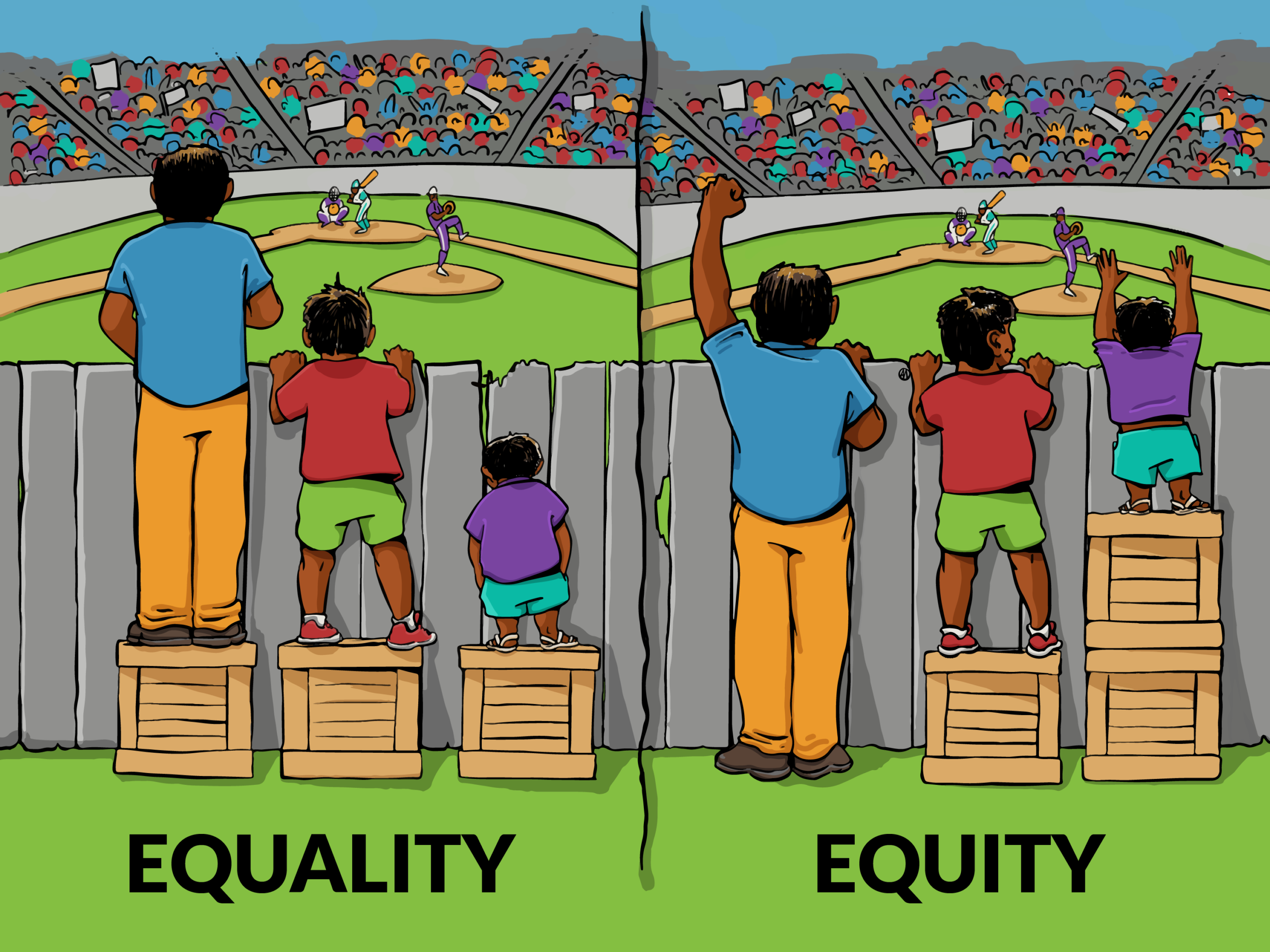
There is a difference between recognizing that colorblind rules can sometimes preserve unequal conditions and abandoning the aspiration to judge individuals without regard to race. The first is a practical observation. The second is a change in the moral standard.
The social consequences were visible in the experience of people who found themselves on the wrong side of the new framework. Students reported feeling that their racial identity had become a source of suspicion or guilt. Employees found themselves asked to participate in training exercises that assigned them a position within a racial hierarchy. People who questioned the assumptions of the new programs could be told that their resistance demonstrated the very bias the programs were intended to correct.
Some of these accounts were exaggerated; others were sincere descriptions of real experiences. The important point is that a system intended to overcome racial classification was increasingly relying on racial classification as its primary instrument.
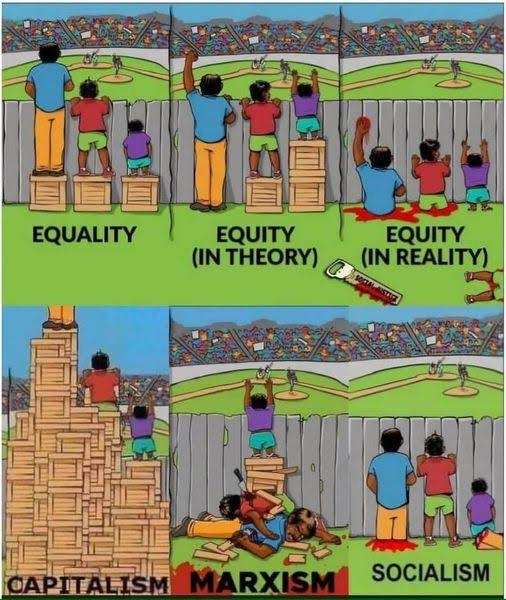
Historian Jacques Barzun warned against this kind of reversal. “To replace the supremacy of one race with that of another,” he observed, “would leave social justice as violated as before.” The point is not that every race-conscious policy is equivalent to racial supremacy. It is that the moral standard must remain capable of distinguishing between justice and injustice independently of the identity of the people who benefit.
The epistemological cost was greater still.
The American intellectual tradition had developed a set of practices for correcting error. Science required hypotheses to be tested against evidence. Law required claims to be established through rules of evidence and adversarial examination. Journalism required verification and correction. Universities required arguments to survive criticism. None of these systems was perfect. All were vulnerable to bias, incentives, and institutional self-interest. But each contained mechanisms by which its own errors could be exposed.
The new framework challenged those mechanisms at their foundations. Objectivity was treated as a product of power. Neutrality was treated as an instrument of domination. Merit was treated as a convention that could reproduce inherited advantage. Evidence was treated as inseparable from the social position of the person interpreting it. The standards by which claims could be tested were themselves placed on trial.
The irony is that the critique required the very intellectual practices it sought to discredit. To demonstrate that a legal doctrine was biased required evidence. To establish that a school system perpetuated racial inequality required measurement. To show that a hiring practice was discriminatory required comparison. To argue that an institution was unjust required some account of what justice would look like.
One cannot expose a contradiction without relying on the principle of noncontradiction. One cannot accuse another person of being wrong without presupposing some standard by which right and wrong can be distinguished. And one cannot demand that an institution correct its errors while denying that there are reliable ways to identify them.
A statement that cannot be denied is a statement that cannot be examined. A theory that cannot fail cannot succeed either. It can only be imposed, or resisted.
That is the central problem. The issue is not whether CRT has identified real injustices. It has, and the broader intellectual tradition from which it emerged contains important work on discrimination, institutional power, and the persistence of racial inequality. Nor is the issue whether the country should continue examining the consequences of its history. It should. The issue is what happens when a theory’s explanatory framework becomes so comprehensive that no evidence can count against it, no criticism can be heard on its own terms, and no standard remains outside the theory by which its claims can be judged.
The principle that made the civil-rights movement possible was that the country could be held to a standard beyond the interests of the people who governed it. The standard applied to everyone, including those who had written it. It allowed the abolitionists to indict the Founders, Douglass to indict the nation, and King to demand that America honor its own promise. It was powerful because it did not depend on the identity of the person making the accusation. It depended on the truth of the accusation.
That principle was not perfect, and it did not end racial injustice. But it provided a means of identifying injustice and a language in which to demand its correction. The movement that inherited its achievements increasingly came to regard the standard itself as an instrument of oppression.
This is the capture. Not simply the capture of universities, newsrooms, corporations, or government agencies by a political movement. It is the capture of the standards by which those institutions distinguish truth from falsehood, justice from injustice, and legitimate criticism from ideological conformity.
The tragedy is that the instrument which delivered abolition, citizenship, equal protection, and the civil-rights revolution was put on trial just as its work was approaching its greatest success. The heirs of those who had used it to demand equal treatment increasingly argued that equal treatment was the problem.
When a society fails to distinguish between a claim and the evidence for that claim, between an accusation and its proof, or between a moral principle and the political program conducted in its name, it has lost something more important than consensus.
It has lost the means by which consensus might ever be reached.