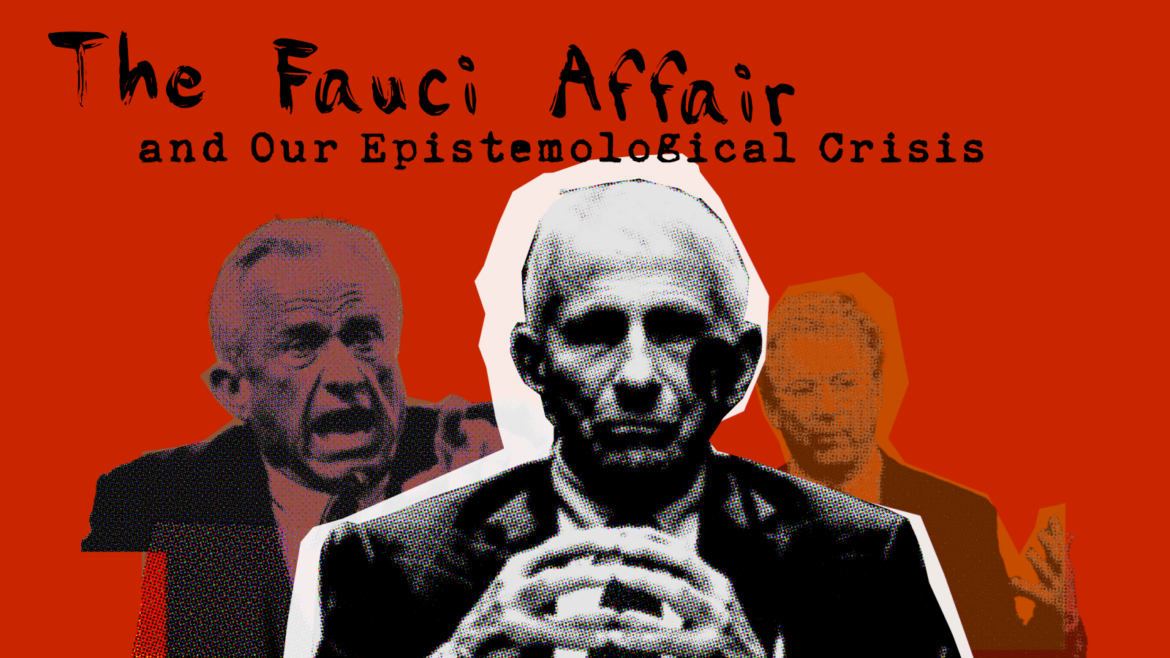
The Fauci Affair and Our Epistemological Crisis
This is part of a series of essays that examine the current epistemological crisis.
PART I: The Fauci Affair and Our Epistemological Crisis
PART II: A Theory of Epistemological Stasis and Crisis
PART III: How We Got Here: The Hollow Stasis
PART IV: The Long Dissolution
PART V: Childhood Vaccines: A Case Study in Epistemological Dissolution
PART VI: A Million Tiny Pieces: Descent into Epistemological Crisis
PART VII: The Postmodern Coup
On July 29, 2026, Anthony Fauci sat down before the Senate Homeland Security and Governmental Affairs Committee and, more than one hundred times, said a single sentence: “Under the advice of my attorneys, I will invoke my right under the Fifth Amendment of the Constitution to refrain from answering your questions.” A week later the committee voted 8–7, precisely along party lines, to hold him in contempt of Congress and referred him to the Justice Department for prosecution.
That is what happened. What it meant depended entirely on whom you asked.
To one half of the country, a hundred invocations of the right against self-incrimination was the confession that fifty years of testimony had withheld: the architect of the American pandemic response, a man who had lied to the public about the virus’s origins and the vaccines’ limits and the basis for the rules that closed their schools and businesses, finally cornered, and pleading the Fifth because the truthful answers would have been criminal ones.
To the other half, it was the only sane response available. An eighty-five-year-old public servant had been subpoenaed by a senator who, as Fauci’s lawyers noted, had spent years making “repeated public and absolutely baseless pronouncements… that Dr. Fauci should be prosecuted and jailed.” No competent attorney would let a client answer questions from a prosecutor who has pre-announced the verdict. Fauci himself called it an “unhinged obsession” and said the point of the exercise was to see him “behind bars.” For millions of Americans the scene evoked something older and uglier: a legislative committee, a hostile chairman, a citizen made to answer for his associations. McCarthyism, with a lab coat.
One hearing. Two worlds.
Days before the hearing, the committee had released more than 1,100 pages of Fauci’s private diary from the pandemic years, pulled off government servers and posted to the committee’s public reading room, with Senator Paul announcing that what Fauci “wrote privately and what he told the country are two different stories.” There it was, in black and white — a smoking gun in his own handwriting.
But to half of the country, those same pages were the unremarkable notebook of an exhausted civil servant — it showed not deceit or malice but scientific humility, responsibility, heroism. To them, the real scandal was the diary’s release itself: a personal journal seized and published without warning, including unredacted medical details of private citizens that had to be scrubbed after the fact.
Same words. Same pages. Opposite meanings.
How is this possible?
How do two large populations of sane, literate, well-intentioned people look at the same thing — a pleading of the Fifth, or a line in a diary, and come away with irreconcilable accounts of what is in front of them?
It isn’t confined to Fauci. Run the exercise on almost anything of consequence in American life and the same split appears. A jury verdict. A viral video of an arrest. An election audit. A war. A set of crime statistics. A president’s phone call. Even when the underlying facts are public, undisputed in their particulars, available to anyone who wants them, the country divides cleanly in two the moment anyone asks what they show. We have grown so used to this that we have stopped finding it strange.
It is very strange.
Researcher Hans Mahncke, surveying the wreckage, put the problem as sharply as anyone has: Americans, he wrote, are no longer merely drawing different conclusions from the same evidence but are “living in entirely different realities”. Before you can argue with an ordinary person about any of this, you must first dismantle a decade of accumulated spin and omission; most people will never encounter the underlying documents at all; and a country cannot function indefinitely when its citizens can no longer discuss anything on the basis of shared factual knowledge.
More than a decade ago the Internet briefly obsessed over a photograph of a dress that some people saw as blue and black and others as white and gold, with neither camp able to believe that the other camp could see it any other way. That was a delightful parlor trick, because the stakes were zero and because the explanation turned out to be innocent: The image was genuinely ambiguous, and each viewer’s visual system was silently making a different assumption about the light.
The Fauci affair is the same phenomenon but with the stakes at maximum. It is arguably the largest story of the century so far — a global catastrophe, millions dead, trillions spent, schools and churches and businesses closed by decree, a generation of children set back, an unprecedented experiment in compelled medical treatment, and the most consequential scientific questions of our lifetimes still formally unresolved. If a country cannot converge on the meaning of that — with the documents public and the principal under oath — then the disagreement is no longer about the pandemic. Something has gone wrong with the machinery by which the people come to believe anything at all.
There is a name for what has gone wrong. The philosopher Alasdair MacIntyre, in a 1977 essay, called it an ‘epistemological crisis’, and his definition is worth carrying through everything that follows: It is not the presence of disagreement, however bitter. It is the breakdown of the means of resolving disagreement. A culture in crisis has not lost its facts. It has lost its courts.
MacIntyre begins, tellingly, not with politics or science but with ordinary life: A man believes he is valued by his colleagues and is fired without warning. A man is proposed for a club by those he takes to be close friends, and is blackballed. Someone discovers, too late, that he was entirely wrong about a person he loved. In each case, what one thought was the case was suddenly proven not to be the case. It wasn’t that he gained new knowledge more than he discovered that his old knowledge was suddenly wrong, and along with it how he came to believe it at all. The warm greeting in the corridor: friendship, or management? The pattern of the last three years: mentorship, or maneuvering? He cannot say, because saying would require exactly the interpretive scheme that just failed him. And the vertigo does not stop with the facts. It moves to the faculty that produced them — ‘How did I come to believe any of this so confidently?’ — and then to the ground beneath that: ‘Can I read people at all?’ and ‘Is the world intelligible in the first place?’
An epistemological crisis at the scale of a civilization is that same vertigo, running through a whole society at once. A country comes to know the way a person does, only bigger and slower. Each of us learns a little firsthand, then we write things down, teach them, test them, and crystallize them into institutions — schools, journals, courts, agencies, professions, the press — which is how a child born this morning inherits ten thousand years of knowledge. Nearly everything you know arrived that way. And, when that machinery is caught failing in public, the same sequence unfolds one order of magnitude up: First people doubt the institutions, then the knowledge those institutions gave them, then their own capacity to know anything secondhand at all — and finally, at the far edge, whether there is a truth of the matter to be had.
The result of such a crisis is not that one side believes one thing and the other side believes another. That is ordinary disagreement, and free countries run on it. The result is that each side increasingly regards the other’s entire way of knowing as illegitimate — not mistaken, but disqualified: credentials as a con, journalism as a psyop, independent research as crankery, lived experience as evidence or as delusion, courts and agencies and peer review as either the last defenses of truth or the machinery of a lie. When that happens there is no longer any move available that could settle a dispute, because there is no longer anything both parties would accept as settling it. That is what a country looks like when it has lost its courts. And that is what the Fauci affair, more clearly than any other event of our time, reveals about the country we now live in.
What follows is an attempt to read that affair properly, to set out the anatomy of such crises and how they have ended before, to trace how ours came about, and then to deliver the only kind of verdict a crisis like this permits — one rendered by named standards rather than by tribe.
This is part of a series of essays that examine the current epistemological crisis.
PART I: The Fauci Affair and Our Epistemological Crisis
PART II: A Theory of Epistemological Stasis and Crisis
PART III: How We Got Here: The Hollow Stasis
PART IV: The Long Dissolution
PART V: Childhood Vaccines: A Case Study in Epistemological Dissolution
PART VI: A Million Tiny Pieces: Descent into Epistemological Crisis
PART VII: The Postmodern Coup