A Theory of Epistemological Stasis and Crisis
This is part of a series of essays that examine the current epistemological crisis.
PART I: The Fauci Affair and Our Epistemological Crisis
PART II: A Theory of Epistemological Stasis and Crisis
PART III: How We Got Here: The Hollow Stasis
PART IV: The Long Dissolution
PART V: Childhood Vaccines: A Case Study in Epistemological Dissolution
PART VI: A Million Tiny Pieces: Descent into Epistemological Crisis
PART VII: The Postmodern Coup
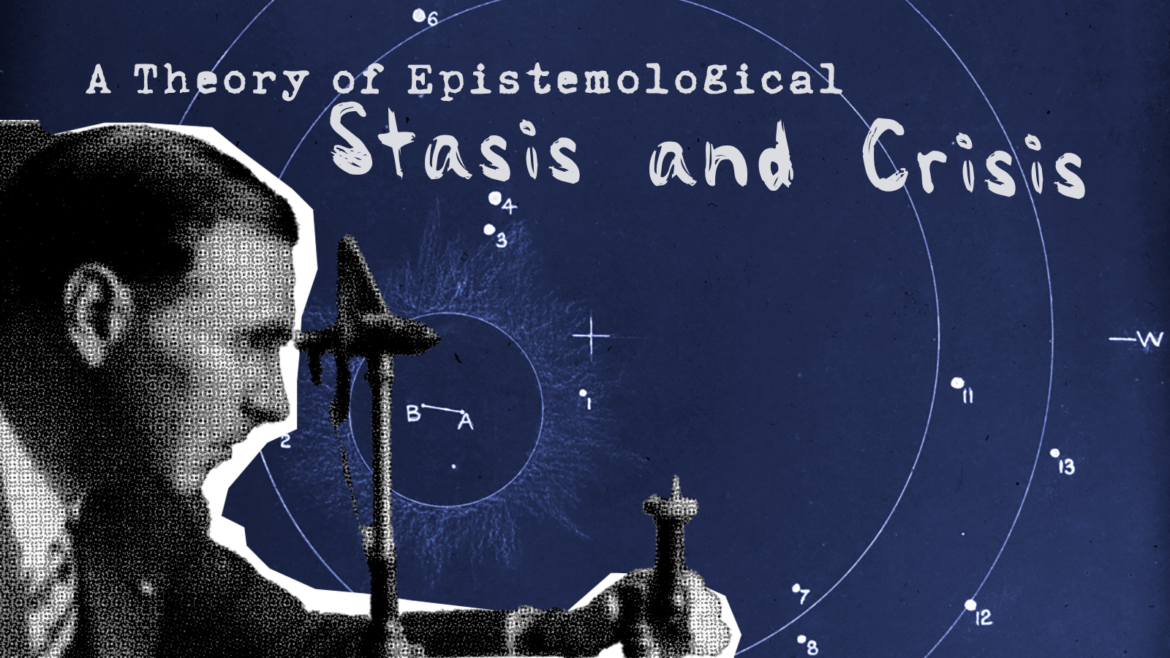
On the morning of May 29, 1919, two British expeditions had traveled to distant sides of the globe to photograph a total eclipse — one on the island of Príncipe off West Africa, led by Arthur Eddington, the other at Sobral in northern Brazil. Their purpose was to measure whether starlight passing near the sun was deflected by its gravity, and if so, by how much. Newton’s physics predicted one figure. A new theory of gravity by a German physicist named Albert Einstein predicted roughly twice that. The plates would decide.
Consider what that undertaking required of the people who mounted it. The armistice was six months old. Britain had buried three quarters of a million men, and the theory under test had been written by a German-born physicist in Berlin — worked out, in fact, while the German army was shelling Paris. Eddington was a Quaker who had nearly gone to prison rather than fight. The expeditions had been planned in the middle of the war, to test an enemy national’s overthrow of England’s greatest scientific hero, using English telescopes and English money.
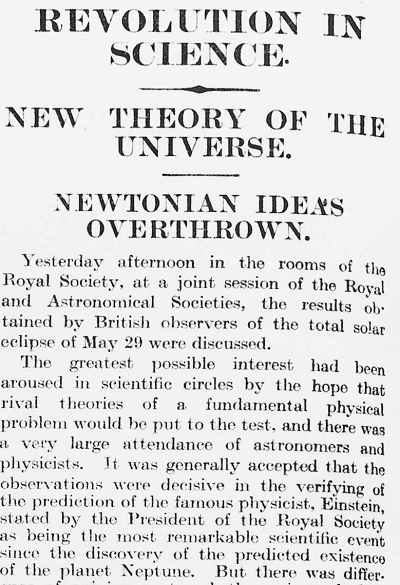
The results were announced on November 6 at a joint meeting of the Royal Society and the Royal Astronomical Society, in a room where Newton’s portrait hung on the wall. The deflection matched the new prediction. The next morning the Times of London ran a triple-decker headline — “Revolution in Science / New Theory of the Universe / Newtonian Ideas Overthrown” — a few columns away from the notices for the first Armistice Day. Within days Einstein was the most famous scientist alive.
Now notice what did not happen. Nobody argued that the plates were fabricated. No faction announced that light-bending was a German hoax and that patriotic Englishmen would continue to hold with Newton. The physicists who had spent their careers on Newtonian gravitation did not caucus and vote. They looked at the number, and they conceded — and this in a country that had every national, professional, and emotional reason not to.
That is what an epistemological stasis looks like. Not agreement — the whole point is that they had disagreed, sharply, about which theory was true. What they shared was something else: everyone knew in advance what each theory predicted, what measurement would distinguish them, what would count as a good plate and a bad one, and which institution had standing to verify and adjudicate. The criteria were settled before the evidence arrived, which is precisely why the evidence could settle anything. And nobody at that meeting congratulated themselves on having shared criteria, because nobody noticed them. It was simply how things were done — the plumbing of the age.
The conclusion even survived its own audit. In 1980 two philosophers of science alleged that Eddington had thrown out the one data set that favored Newton because he wanted Einstein to win. The charge was serious, and it was taken seriously: the Greenwich plates were re-measured with modern equipment, the archival record was combed, and recent scholarship has largely defended the original decision as methodologically justified rather than motivated. Whatever one concludes about Eddington’s thumb on the scale, note what the century-long argument demonstrates: a criteria layer in working order keeps checking itself, in public, using standards its participants agree to in advance.
Sixteen photographic plates overturned Isaac Newton in six months. Eleven hundred pages of diary, in our own time, moved no one at all. The difference is not in the evidence. It is in everything that surrounds evidence and gives it the power to decide.
The Model of Epistemological Cycles
A culture that has lost its courts is easy to name and hard to picture, so before going further it is worth slowing down and laying out the machinery — what the courts actually are, what they sit on top of, and what exactly gives way when they fall.
To see it, start with how we come to know anything at all.
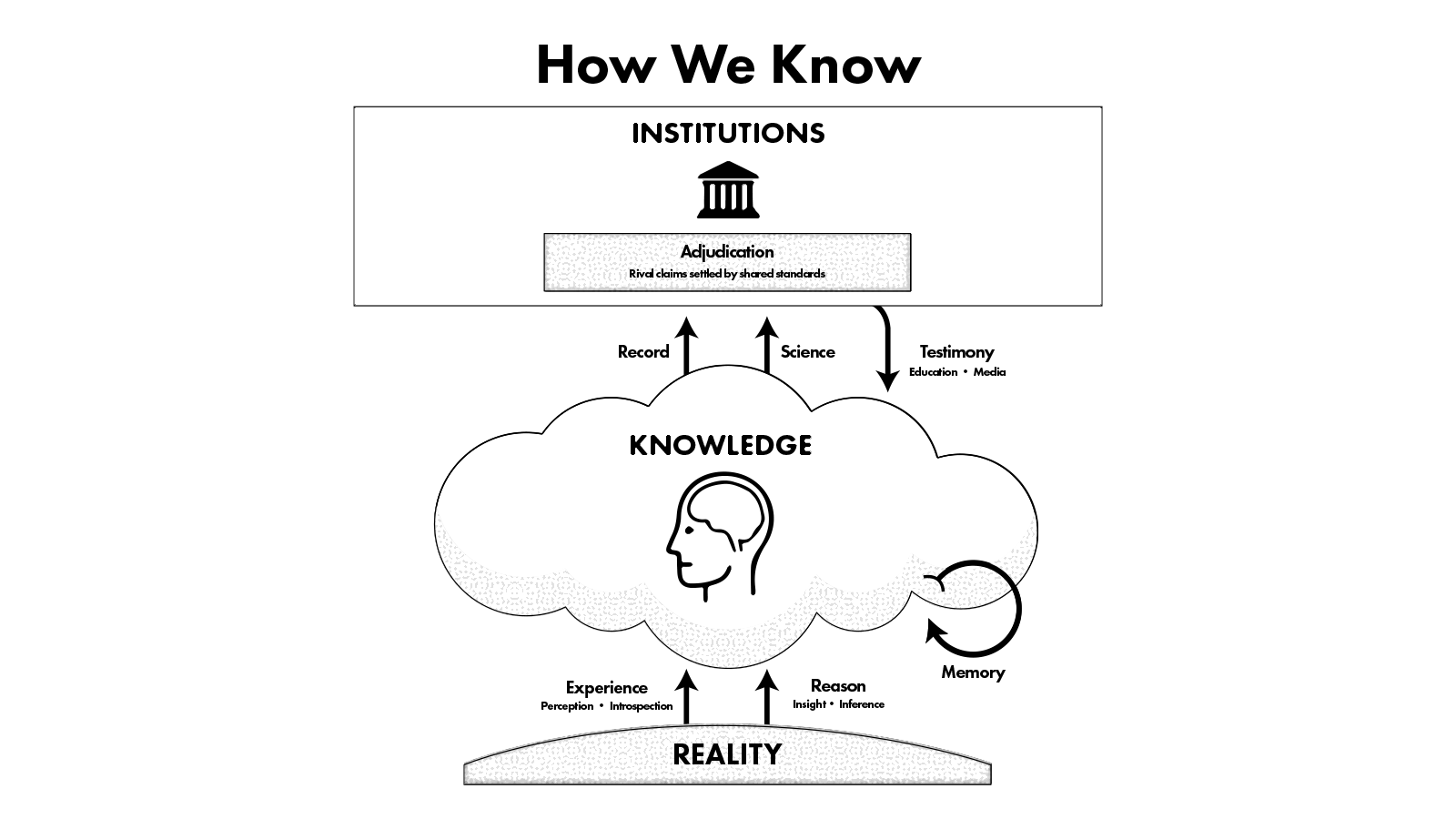
It works on three layers. The ground layer is Reality — truth manifest: the world that is whatever it is regardless of what anyone believes about it. Nobody builds this layer, and nobody can renovate it.
From that ground, knowledge rises into each human mind through exactly two channels. The first is Experience: perception of the world outside us, and awareness of the world within. The second is Reason: the direct insight that grasps what must be so — two and two are four, a thing cannot both be and not be — and the inference that works out what follows from what. Everything you have ever known firsthand came up one of those two arrows. And it stays usable because of the small loop drawn inside the knowledge layer: Memory, which carries yesterday’s knowledge into today, so that none of us is condemned to relearn the world every morning.
But notice how little those two arrows actually deliver, and how early they deliver it. Most of what a human being will ever learn by raw perception is in hand by early childhood: objects persist, fire burns, falls hurt, faces mean things. Most of what unaided reason will ever grasp is in hand by adulthood. Now inventory everything else you know — history, medicine, law, the shape of the earth, the composition of the sun, the contents of laboratories, the safety of your food and your money — and ask how it got into your head. None of it came up the two arrows. All of it came down, from the third layer.
The third layer is what humanity does with knowledge so that it does not die with its knowers. Out of millions of individual minds, knowledge flows upward through two channels of its own — call them Science, the organized checking of claims, and Record, the writing of them down — and crystallizes into institutions: books, schools, churches, courts, journals, professions, governments. And the institutions send it back down into every new mind in every new generation, through the channel philosophers call Testimony — the taking of another’s word — here industrialized as education, media, licensure, peer review. The institutions are, in effect, a culture’s criteria made flesh, its standing answer to the question of whose word counts and how claims get checked.
None of this is modern. The third layer is as old as speech, and its workings are easiest to watch in the smallest and oldest version of it, before it acquired buildings and budgets and a vocabulary of its own.
Picture a village. It is five thousand years ago, somewhere with a river. The people there know a great deal. They know when the river floods, which plants stop a wound from bleeding, which water sickens a child, and that the red berries at the wood’s edge will kill a man by morning. Every one of those facts was bought the hard way, by watching, and most of them were paid for with somebody’s life.
Then they face the problem every society faces: The people who know these things die. In a world without writing there is exactly one way to make knowledge outlive its knower, and that is to bind it into story, song, ritual, and taboo. So the village does what every pre-literate culture on earth has done. Plant when the god’s eye rises over the mountain. A spirit dwells in the low well, and to drink there is to take its anger into you. The red berry is the blood of the enemy of the people, and the child who eats it joins him.
A modern reader smiles at this. Hold the smile for a few pages, because the crucial thing about that village’s mythology is not that it is primitive. It is that it is true. The star really does rise when the flood is coming. The low well really is contaminated. The berry really does kill. The ritual calendar is an astronomical instrument that happens to be written in narrative, because narrative is the only durable storage medium available. The myth is not a substitute for knowledge. It is a container for it. And the priests who keep it are not running a racket; they are the record-keeping layer of a civilization, with legs.
This is the miracle on which civilization runs: because the third layer exists, a child born this morning inherits ten thousand years of other people’s experience and reason. It is also the layer that carries nearly everything. Ask what you actually know by your own two arrows, and the honest answer is: that it’s raining, that your keys are on the hook, that two and two are four. The rest is testimony. Which means the rest is trust. The village child learns none of it by experiment. He does not test the berry. He takes it on the word of people he did not choose to trust, about events he never witnessed — and the trust is entirely rational, because the alternative is to eat the berry.
Stasis
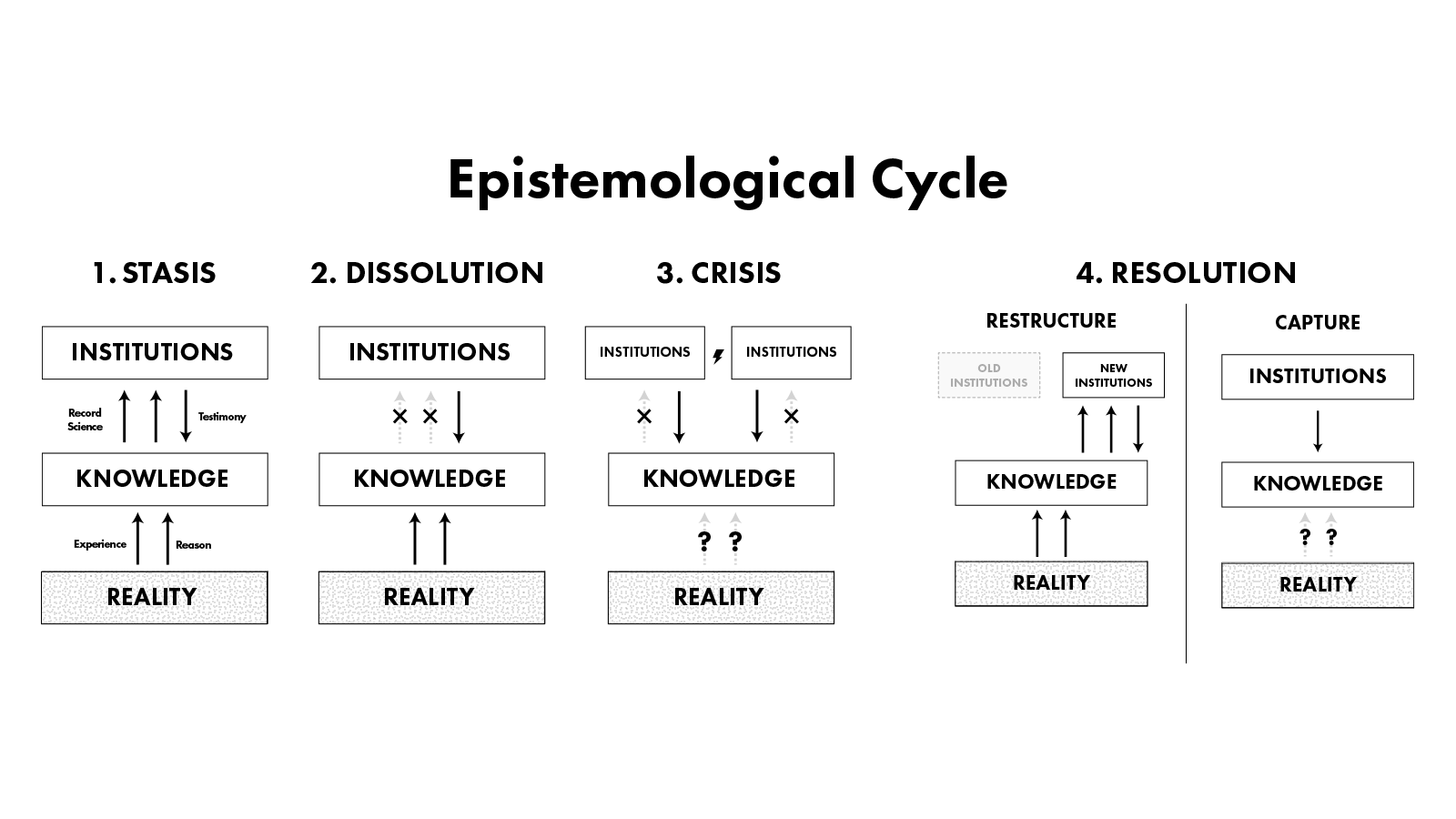
When the institutions are settled — when the testimony flowing down keeps agreeing with or integrating whatever the two lower arrows happen to deliver, whenever anyone happens to check — the third layer does something remarkable: it disappears. The map matches the coastline every time someone sails it; the medicine works; the bridge holds; the plane lands. Nobody in such an age thinks about why they believe the boiling point of water, any more than they think about the plumbing that delivered the water; you just turn the tap and knowledge comes out. This condition is what might be called epistemological stasis, and it is the foundation for all great civilization.
And notice what “objectivity” looks like: everyone confident that all three layers are aligned. It is not humanity’s natural resting state, occasionally lapsed from. It is an achievement, like clean water — the condition of institutions built so well, and verified so routinely, that everyone can forget they exist.
And here is the double nature of the third layer. Its scope makes it mighty — it is most of what any of us “knows” — but its scope is purchased by abstraction: nearly all of it stands many degrees from anyone’s living experience or reasoning, including yours, including your teachers’. You cannot re-derive medicine, re-witness history, or re-run the experiments; life is too short by centuries. So in daily practice the layer’s power over minds is exercised not as freshly demonstrated truth but as inertia — curriculum, custom, credential, authority, the sheer weight of what everyone around you already accepts. In a healthy age that authority is earned, built out of checked experience and disciplined reason. But it is not re-earned in the moment of use; it is extended on credit. We might call that credit the right not to check — the default that lets you board an airplane without studying aeronautics, swallow a pill without reading the trials, believe in Antarctica without sailing there. The right not to check is what makes modern life possible. It is also what makes the third layer uniquely dangerous: The mightiest level of the structure is the one that can drift, decay, or be captured without its users noticing — because its users, by design, are not checking.
Notice what the village has bundled. The myth carries the knowledge and the authority, welded together, and after enough generations nobody can separate them, because nobody remembers that someone once simply watched the star and noticed. The knowing and the ruling have become one object. Every third layer that has ever existed does this, and it is not a defect anyone chose.
That vulnerability is not merely a hazard institutions happen to run. It is a tendency their own success produces, and it is worth stating as a principle here, because every case in this essay will illustrate it. An institution that works attracts reliance; reliance enables scale; and scale eventually makes direct verification impossible even for the people inside it, who must then judge one another by proxies — credential, office, prestige, publication, citation — standing in for the checking that no longer occurs. The proxies are not decadent. They are necessary, and they work exactly as long as they track the thing they replaced.
But a measure that becomes a target stops measuring. So the third layer drifts from the ground beneath it at a rate roughly proportional to how well it is doing, and, as such, the healthiest stasis is always quietly manufacturing the conditions of its own crisis. Will Durant, surveying the fall of Rome, concluded that a great civilization is destroyed from within before it is conquered from without. The same holds for the machinery of knowing. A culture might have detractors from the outside, but not one of them would work on a structure that had not already hollowed itself.
Crisis
Then comes conflict. At a certain point, the institutions’ inertia has carried them to an extent that the knowledge floating down from them in the form of testimony does not match the knowledge floating up from reality in the form of experience and reason. Anomalies mount and the typical modes of verification and adjudication cannot reconcile the difference. The outcome is a split — between institutions and individuals, between groups of institutions, or between entire cultures.
Return to the village, because it shows the whole mechanism with no villain in it. Centuries pass. The stars precess, slowly, as they do. The god’s eye now rises ten days before the flood, and the crops planted on the old signal fail. The priests go on reciting what they were taught, because by now reciting is what the office consists of; not one of them ever watched a star and noticed anything, any more than a modern official has personally replicated a study.
Then a farmer notices. Planting by the star fails; planting ten days later works.
Watch why the priests cannot simply concede the ten days. The timing is not a loose fact sitting in their system; it is fastened to the god, and the god to the legitimacy of the priesthood, and the priesthood to the ordering of the whole society — the marriages it blesses, the disputes it settles, the reason anyone obeys anyone. To give up the ten days is to give up the god. They are not lying and they are not fools, and they are not entirely wrong to fear that if the god goes, a great deal goes with him. Meanwhile the farmer has one season of observation against ten thousand years of inherited wisdom that has demonstrably kept his people alive — and most farmers who think they have overturned the calendar are wrong.
Two positions, both rational, and no shared method for deciding between them. That is an epistemological crisis in its simplest possible form, and notice that it required no dishonesty from anyone.
History knows two classic igniters. The first is contact: Another people arrives carrying a different stack — different books, different schools, different gods, different sciences — and suddenly two institutional layers claim the same minds, with no fourth layer above them to judge between. The second is change: New technology, new discoveries, new institutional failures unsettle what had been settled, and the testimony coming down no longer matches what experience and reason send up — the officials say one thing and the checkable world says another. In some cases, as our own, both igniters are active.
What happens next is the crisis proper, and it takes two forms — usually in the same society, often in the same person. The first is entrenchment. Institutions under attack stop functioning as conduits of truth and begin functioning as fortresses of identity: my layer, right because mine. Since no human being can personally check even a fraction of what the right-not-to-check used to deliver, the revocation of that right does not produce a nation of independent verifiers; it produces tribes — adjudication relocated to the only courts still open, the self and the group, with “my people say so” installed as the substitute for the fallen shared standard. From the inside this feels like clarity, even courage; from the outside it looks like madness; it is neither — it is the crash position of a rational creature whose verification layer has failed.
The two levels feed each other, which is why the condition is stable rather than self-correcting. Hardened institutions give individuals more reason to retreat into tribes; hardened tribes give institutions more reason to treat every criticism as an attack. And a further mechanism drives both toward the extreme over time. When a group meets evidence against its position, the members least committed to it leave first — which raises the average commitment of everyone remaining, which makes the environment less tolerable for the next-least committed, who leave in turn. The group does not shrink toward moderation. It distills. This is why, as a controversy ages, the most reasonable participants tend to fall silent and the field is left to those with the least judgment and the most certainty. It is not that the extremists won the argument. It is that everyone capable of doubting it went home.
And entrenchment has a characteristic weapon, worth naming because it will appear in nearly every case we review. When a position can no longer be defended on the evidence but cannot be surrendered either, the reliable move is to change the kind of claim it is: an empirical dispute is re-categorized as a moral one, so that the data show X is answered with you are a bad person for saying X. This moralization is a category error, and it is enormously effective, because a moral charge cannot be answered with evidence — the accused can only deny being wicked, which sounds exactly like what a wicked person would say.
Moralization is also the hinge between the two exits described below. Entrenchment by itself is defensive: we hold our ground because it is ours. Capture requires enforcement — and moralization is the conversion, because it turns a question of fact into a test of loyalty, and loyalty tests can be administered by people who have no argument at all: a plagiarism charge answered with an inquiry into the accuser’s racism, an argument about a policy reclassified as an injury, an epidemiological judgment indexed to the politics of the crowd. In every case the same operation is performed. The question is not refuted. It is relocated to a court where evidence is inadmissible.
The second form is abandonment, and it runs in the opposite direction: doubt, once loosed on the institutions, does not stay there. It cascades down the stack — first the third layer’s testimony (“the experts lie”), then the knowledge the layer had installed (“everything I was taught is suspect”), and finally, at the limit, the ground itself: the decadent turn that announces there is no truth, only narratives; no reason, only power. This is the deepest reach of the disease, and history’s consolation is that it is self-limiting — the ground cannot actually be vacated, because everyone denying reason at the podium still used it to find the podium, and reality goes on enforcing itself with total indifference to every narrative. But a culture can do itself generations of damage in the meantime, because institutions are built out of what people say, even when it contradicts what they cannot help but do.
The village has a figure for this too: The young man who learns that the priests were wrong about the star and concludes that they were lying about everything. He drinks from the low well. He eats the red berry. The priests were wrong about ten days and right about the water and the fruit, and he has no way left to tell which was which — because the instrument that used to sort true from false was the very authority he has just discarded, and he has built nothing to replace it. Reality settles the matter without consulting his opinion of the priesthood.
Tribe Over Truth
Name the signature and the whole thing fits in a sentence. In stasis, a disputed claim meets the question, ‘How would we know?’ In crisis, it meets the question, ‘Whose is it?’ — and the substitution happens silently, because, in epistemological crisis, the second question is the only one still guaranteed a reliable answer. That is the sense, and the only sense, in which an epistemological crisis is the prioritization of tribe over truth.
The phrase is worth handling carefully, because it invites a diagnosis that is both flattering and useless: that our opponents are people who no longer care about the truth. Almost nobody is that. Nobody experiences the trade off, truth for tribe. Each side experiences itself as the last remaining defender of truth against the other’s delusion, and each is quite sincere — this is what makes the condition so intractable and so exhausting. What has actually happened is not that people stopped valuing truth but that they lost the shared machinery for pursuing it together, and fell back on the only instrument still in working order. Asking ‘Is it ours?’ is not a substitute for asking ‘Is it true?’ in the mind of the person asking it. It is what asking ‘Is it true?’ has been reduced to, once the court that could answer has closed. The tribe becomes the court because the court became a tribe.
Two consequences follow. The first is that exhortation is worthless: Telling a people in this condition to be more open-minded, more rigorous, less tribal, is like telling a city with no water main to be cleaner. The second is that the corruption is invisible to its host. A person sorting by side does not feel himself sorting by side; he feels himself recognizing, at last, who can be trusted — which is why every party to such a crisis can say with perfect honesty that it is the other side that has abandoned the truth.
And now the village can be put away, but not before the point of it is stated plainly, because it has been an argument rather than an illustration.
A modern reader is invited, by every instinct his education has given him, to feel superior to those priests. He should resist. We have not stopped bundling knowledge with authority; we have only stopped using gods for it. Our myths sound like this: that scientific consensus is how science establishes truth; that credentials track competence; that the press checks power; that the courts are neutral; that peer review filters error; that the agencies tell us what they know. Every one of those is a story containing a great deal of real knowledge — each was true enough, often enough, to be worth teaching — and every one of them, exactly like the star-timing, has the authority of an institution fastened to it, so that the knowledge cannot be revised without the authority taking the wound.
Which is why, when a claim in that bundle fails, the institution so rarely concedes cleanly. It is not usually lying. It is doing what the priests did: defending the thing it believes holds everything else up. Keep the picture in mind through the chapters that follow, because it explains a detail that is otherwise inexplicable — that the six-foot distancing rule went on being enforced long after the man at the center of the American pandemic response could no longer say where the number had come from. Six feet was never only a number. It was a tool of an authority that had been entrusted to save a population from catastrophe. To concede the one was to concede all of it.
The open period between a fallen stasis and the next one is the interregnum that feels like a dark age. History records exactly two exits from it. Either reconstruction: new institutions get built, honest enough about the old ones’ failures — and their successes — to eventually earn back alignment. Or capture: one faction imposes its stack by force or exhaustion and calls the imposition truth. Reconstruction tends toward the next epistemological stasis and a new cycle. Capture tends toward tyranny, and toward the long decline of a people who can no longer correct themselves.
A caveat before the cases. Like all periodizations of complex cultural things, these are clarifying simplifications, not clean boxes: a stasis decays for decades before anyone remarks on it, solvents work slowly and overlap, and crisis and reconstruction frequently run at the same time in different rooms — the wars of religion were still being fought while the men who would charter the Royal Society were already at work. A society can also hold stasis in one domain while another is in ruins, which is our own condition and the subject of much of what follows. But blurred edges do not mean the phases are arbitrary. They are identified by their signature rather than their dates — by whether disputes have a venue that both parties accept — and on that test the transitions are unmistakable, even when their exact dates are not.
By the same token, it must be admitted that not all epistemological cycles bear the same historical weight. History admits but a few major cycles, identified by the fact that the institutions defined entire civilizations for centuries and in whose crisis was so devastating that those institutions, the criteria layer itself, had to be rebuilt from the foundation, because the old machinery could not be repaired by any operation that the old machinery recognized. Archaic Greece and Medieval Christendom are recognized as the two major cycles in the history of Western Civilization. Our own period belongs, on every available indication, in this category as well.
A brief summary of each major and minor cycle offers a bird’s eye view:
Archaic Greece. For centuries the Greek world knew what it knew by inheritance: the poets were the custodians, the past was memorized and recited, and Homer supplied the shared framework of gods, honor, and human limitation within which any claim about the world made sense. The solvents arrived together in the fifth century. Alphabetic literacy meant that assertions could be set side by side on a page and compared, which is the beginning of criticism. Trade and colonization put Greeks among peoples whose customs contradicted their own — Herodotus, touring the Mediterranean, reported that every nation believes its own funeral rites to be the only decent ones, and concluded that custom is king of all. And democracy made persuasion the currency of power, which created a market: the Sophists, who taught, for a fee, how to win an argument regardless of its merits. The crisis followed directly. If a claim’s fate is decided by the assembly, and the assembly can be moved by whoever argues best, then Protagoras is right that man is the measure of all things, and truth reduces to whatever prevails. Athens lived that conclusion out and, in 399 BCE, voted to execute a man for asking questions. The resolution came from Socrates’ students. Plato and Aristotle set out to show that reasoning has rules — standards of validity that hold no matter who is speaking, how charming he is, or how the room is leaning — and Aristotle’s logical works, together with the Academy and the Lyceum, gave the Western world its first purpose-built criteria layer.
Medieval Christendom. By the thirteenth century Europe had achieved a stasis of remarkable coherence: one Church, one Book, one cosmos, Latin as the universal language of learning, and a scholastic synthesis that had folded Aristotle into revelation so thoroughly that reason and faith were understood as two paths up one mountain. Disputes were real and fierce, but they had a venue and a method. Then came the solvents. The slowest-acting had already been at work for two centuries: the nominalist turn of Abelard, Duns Scotus, and above all William of Ockham, which held that universals are names rather than realities — that the categories by which we sort the world are conventions of language rather than discoveries about it, a loosening whose full consequences would take four centuries to arrive. The rest came nearly at once: The printing press dropped the cost of reproducing a text by orders of magnitude; the New World produced peoples unaccounted for in scripture or in Ptolemy; the rediscovery and Latin translation of the ancient skeptic Sextus Empiricus handed Europe a ready-made vocabulary for doubt; and the Reformation’s appeal to scripture alone made every literate believer his own interpreter. The crisis that followed was structural, not merely doctrinal, and contemporaries named it precisely: the rule of faith problem. If Rome says one thing and Wittenberg says another, by what standard does one choose — and by what standard does one choose that standard? There was no answer inside the system. What followed was a century of pamphlet warfare and actual warfare, ending in exhaustion at Westphalia in 1648, with Montaigne’s question — what do I know? — as the age’s motto. The resolution, when it came, was procedural rather than doctrinal: the Royal Society, founded in 1660 and chartered two years later under the motto nullius in verba, “take nobody’s word for it,” which replaced the authority of persons with the authority of witnessed, published, repeatable experiment. It worked spectacularly for natural philosophy. It left the questions of meaning and value unresolved, which is a debt the West is still servicing.
The American custodial order. And then our own, which the next section takes up in detail: a stasis founded on the liberal Enlightenment order of the eighteenth and nineteenth centuries and solidified through the crucible of world war and depression, resting on federal statistical agencies, the research university, credentialed professions, and a media funnel narrow enough that a nation of two hundred million received the day’s events from a handful of men. Its solvents were the internet, a half-century of institutional betrayals, and contact at planetary scale. Its crisis is the one we are living in. Its resolution has not been written.
Most crises are minor: real, sometimes brutal, but confined to a single domain, or resolved by an existing framework that proved capable of absorbing the shock.
Many belong on the timeline. In the eleventh century al-Ghazali’s Incoherence of the Philosophers pressed the case against the Aristotelian rationalists of the Islamic world; Averroes answered a century later, and the resolution went the other way — philosophy was subordinated to theology, and this is the cautionary entry in the ledger, since reconstruction is a possibility rather than a guarantee. In the thirteenth century Latin Christendom absorbed the same Aristotelian shock and resolved it by integration, in Aquinas’s synthesis, whose method obliged every question to open with the strongest case against itself. In 1440 Lorenzo Valla proved by internal linguistic evidence that the Donation of Constantine — the document underwriting papal temporal authority — was a forgery, which is a criteria-institution working exactly as designed against the most powerful interest in Europe. The eighteenth century’s skeptical crisis, from Hume through Kant and Reid, was resolved for science and left unpaid for morals, a debt still being serviced. The mass-press and propaganda crisis of the late nineteenth century was also one of these minor cycles: the criteria were repaired by a profession inventing standards for itself, and the wider machinery of law, science, and government went on functioning throughout. And between 1900 and 1931, mathematics discovered paradoxes in its own foundations, pursued a program to eliminate them, and had Gödel prove the program impossible — a total defeat at the level of theory that the discipline absorbed without losing a step, because its bottom layer of shared practice never came into question.
Seen side by side, the anatomy is unmistakable.
| The Stasis | The Solvent | The Crisis | The Resolution | |
|---|---|---|---|---|
| MAJOR | Archaic Greece: the Homeric order, wisdom as inherited song | Literacy, democracy, contact, the Sophists | Persuasion for hire; “man is the measure”; Socrates executed | Logic, the Academy and Lyceum — reasoning given rules |
| Minor | Islamic Aristotelianism, 11th c. | al-Ghazali’s critique | Reason versus revelation, unresolved | Philosophy subordinated — the cautionary case |
| Minor | Latin Christendom, 13th c. | Aristotle recovered via Arabic sources | Faith and reason apparently at odds | Thomist synthesis; objections stated first |
| Minor | Papal temporal authority, 15th c. | Humanist philology | A founding document questioned | Valla’s proof of forgery; the historical method |
| MAJOR | Medieval Christendom: one Church, one Book, one cosmos | Nominalism, print, the New World, Sextus recovered, the Reformation | Rival authorities with no umpire; a century of religious war | The Royal Society, witnessed experiment, the journal |
| Minor | Enlightenment confidence, 18th c. | Hume’s skepticism, applied rigorously | Reason undermining its own foundations | Kant’s partition and Reid’s realism — paid for science, unpaid for morals |
| Minor | The liberal print order, 19th c. | Cheap newsprint, then propaganda and radio | Manufactured realities; capture across much of Europe | Professional journalism: sourcing, corrections, bylines |
| Minor | Mathematical foundations, c. 1900 | Paradoxes in set theory | Certainty lost at the root of the most certain field | Gödel; the program abandoned, the discipline intact |
| MAJOR | The American custodial order, c. 1945 | Postmodernism, betrayal, the internet, the lost container | The present interregnum — this essay’s subject | Unwritten |
That is the theory, and the last row is ours — in the major column, where the machinery has to be built rather than mended. Two questions remain to be explored for the purposes of this study: What exactly was our stasis? And what dissolved it? Questions whose answers will help us understand why the condition feels so familiar the moment it is named.
This is part of a series of essays that examine the current epistemological crisis.
PART I: The Fauci Affair and Our Epistemological Crisis
PART II: A Theory of Epistemological Stasis and Crisis
PART III: How We Got Here: The Hollow Stasis
PART IV: The Long Dissolution
PART V: Childhood Vaccines: A Case Study in Epistemological Dissolution
PART VI: A Million Tiny Pieces: Descent into Epistemological Crisis
PART VII: The Postmodern Coup