
The Zipper: How to Merge Properly and Save Civilization
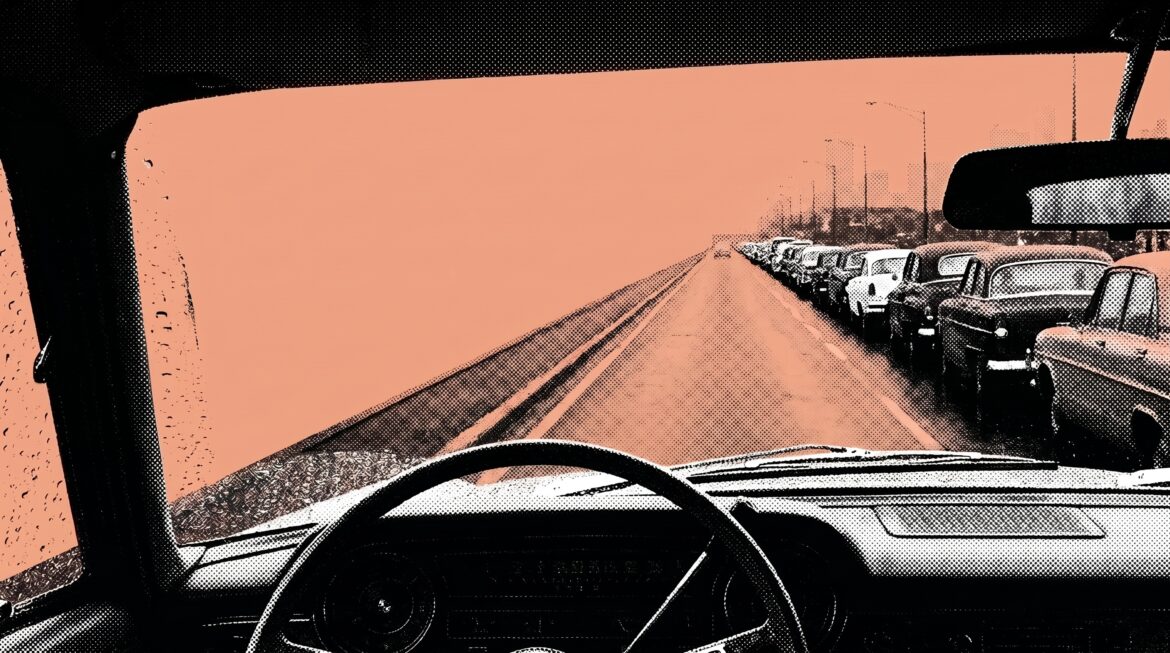
Anyone who has driven on a highway lately has surely experienced one of the great frustrations of modern civilization: the construction merge. It begins with an orange sign announcing that a lane will close in two miles, a warning that somehow guarantees nothing will move for the next twenty minutes. Brake lights bloom to the horizon. Behind the barrels, no one appears to be working. The GPS revises the arrival time upward like a taxi meter.
You merge when you can, trying to make things smoother, but soon you find that the lane you left is now completely empty and you are quicky overcome with a sinking feeling—sooner or later, there will be someone who sees that empty lane and just flies down it to leap-frog everyone in the right lane. And there they go—one, then two, then three. You contemplate getting back in that lane to do the same thing, but the leap-froggers are going so fast that you can’t possibly get back in that lane without causing a fifteen-car pile-up. Best to just stay put and inch forward with the rest of the suckers as the leap-froggers fly by, oblivious to the great injustice they are perpetrating.
It doesn’t have to be like this.
There is a solution to these kinds of fiascoes. It’s called the Zipper, and, when done correctly, it just might save civilization.
The Zipper
Now, much has been shared about the Zipper merge lately, but much of it is misleading. The basic idea is simple: When a lane is closing and traffic is backed up, drivers use both lanes all the way up to the merge point, then take turns filing into the open lane, one from each side, like the teeth of a zipper. Highway agencies endorse it. The internet loves it. And a certain kind of driver has discovered that it makes a convenient alibi.
The case for the zipper merge is real, and it is mostly arithmetic. A lane closure is a bottleneck: Only so many cars per minute can squeeze through the single open lane. That rate does not change with how drivers line up behind it. What changes is the shape of the line.
When most drivers merge early, everyone waiting stacks into one lane, and the backup stretches twice as far as it needs to be (Diagram 1). When drivers use both lanes to the end and take turns at the merge point, the same number of cars waits in half the distance (Diagram 2). The cars don’t get through the bottleneck faster. The line is simply folded in half.
Transportation departments have spent a decade saying so. Minnesota’s DOT says the Zipper Merge reduces the overall length of a backup by as much as 40 percent, and lists “a sense of fairness and equity that all lanes are moving at the same rate” among its benefits. Missouri puts the reduction at 40 to 50 percent. Kansas, Washington, Arizona, Virginia and New Mexico have run campaigns of their own.
The less-quoted finding matters just as much. A Minnesota study found the zipper merge did not cut average travel time at all. A shorter line keeps the backup clear of upstream ramps and evens out speeds between lanes, but it does not deliver anyone to the front sooner. The Zipper is a way of sharing a delay, not escaping one.
The Counterfeit Zipper
Here is the part the articles leave out. The Zipper is not something one driver does. It is something a whole road does. Its benefits come from both lanes filling evenly and emptying in turn. A single car in an abandoned lane produces none of them.
Go back to the leap-frogger. When he reaches the cones, the right lane is still forty cars long. The left lane is still empty. The backup is no shorter for his having driven past it. All he has changed is the order: Everyone behind the point where he cuts in now waits one car longer, so that he can wait forty cars less.
That is the definition of cutting in line. Calling it a Zipper Merge does not change the arithmetic; it only changes the driver’s opinion of himself. A Zipper with teeth on one side is not a Zipper. It is a gap that one person drives through.
The tell is the speed. A driver who is genuinely Zipper Merging moves at the pace of the lane beside him, because the lane beside him is moving at the pace of the merge. A driver who blows past a stopped line at thirty miles an hour is not using both lanes. He is using the one nobody else is using.
How the Zipper Breaks
If the Zipper is so sensible, why does early merging keep winning? Because the Zipper is a cooperative arrangement, and cooperative arrangements are fragile.
Picture a road where it is working: Both lanes full, both lanes creeping forward, cars alternating at the cones (the opening of Diagram 3). Now suppose a driver in the continuing lane decides he will not let anyone in. Perhaps he thinks the left lane is full of cheaters. Perhaps he has been cut off once too often. Either way, he doesn’t let the other cars merge. Suppose the next driver does the same. And the next.
The effect is immediately noticeable. The left lane stops dead while the right lane flows. Cars pile up behind the cones, ten deep, then fifteen, while the drivers to their right roll past. Anyone arriving at the back of the left lane can see the bargain plainly: Stay here and wait twice as long, or move over now.
So they move over. Each driver who merges early is acting reasonably, and each one makes the right lane longer. The stuck cars eventually squeeze in, the left lane empties, and the road settles back into a single long line with an inviting empty lane beside it (the end of Diagram 3). Which is exactly where the leap-frogger finds it.
This is the cycle worth noticing. Early mergers and line-jumpers are not opposing tribes. They are two halves of the same breakdown. Refusal at the merge produces the empty lane, and the empty lane produces the jumper, whose behavior justifies the next refusal.
The Brave Soul
There is a way out of the cycle, and it takes exactly one driver.
He arrives in the left lane while the right lane is forty cars long (the opening of Diagram 4). He does not merge early, and he does not race to the front. He drives up to the back of the right-hand line and stops beside its last car. When that car creeps forward, he creeps forward. When it stops, she stops. He keeps pace with the line all the way to the cones, and takes his turn there.
The effects compound. The leap-froggers, who would have sped past him are now stuck behind him, waiting at the same pace as everyone else. Drivers arriving behind them see a left lane that is moving at the speed of the right lane, which makes it a lane rather than a loophole, so they stay put. The right lane stops being fed by early mergers and begins to shrink. By the time the brave soul reaches the merge, both lanes are full, both are half as long, and the cars are alternating. The Zipper has been rebuilt.
He gained nothing for himself. He reached the cones at the same moment as the car he paced. What he did was refuse both bad options, the early merge that lengthens the line and the sprint that cheats it, and in doing so he made the good option visible to everyone behind him.
A Cooperative Act, Not a Loophole
The Zipper Merge has become a kind of permission slip. Drivers who learned the term online use it to excuse the very behavior that made early merging feel necessary in the first place. They are not wrong that the Zipper works. They are wrong about what it is.
The test is simple. A driver who is Zipper Merging moves at the speed of the lane beside him and takes his turn at the end. A driver who passes a stopped line at speed and then demands a turn is jumping it, whatever he has read.
The obligation runs both ways. Drivers in the continuing lane owe the left lane its turns at the cones, or the Zipper collapses into a single long line. Drivers in the closing lane owe the continuing lane their patience, or the Zipper becomes a fast lane for the shameless. Each side’s bad behavior is the other side’s excuse.
So, next time you’re crawling toward a lane closure, and you’re tempted either to slip over early or to fly down the empty lane, remember what it takes to restore the Zipper. Stay in your lane. Pull up beside the last car in line and move when it moves. Take your turn at the cones, and give one to the driver beside you. You won’t get there any sooner. But the line behind you will be half as long, and the leap-froggers will have nowhere to go.
It might just save civilization.