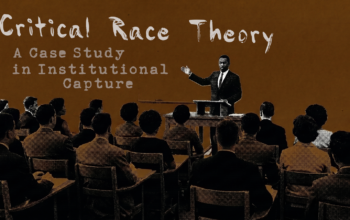
Critical Race Theory: A Case Study in Institutional Capture
Of the campaigns described above, one demands close examination, because it is the most fully developed, the most consequential, and the most widely argued about
Of the campaigns described above, one demands close examination, because it is the most fully developed, the most consequential, and the most widely argued about
Once you’ve discredited reason and disowned objective truth, you cannot make an argument in the traditional sense. So you must argue some other way.
The 77 percent was gone, and it was not coming back, and no exhortation about trusting the experts could possibly retrieve it, because the people had not made an error. They had learned.
The dissolution described in the preceding pages ran across every American institution at once, which makes it difficult to watch closely. So it is worth
A few did not put it aside, and from 1962 forward there existed in America a small population of people who had understood something the majority had declined to understand — and who would be proved right again, and again, and again, for sixty years, all the while being called cranks the entire time.
It was an age, aptly titled the ‘Wonder Years’ by a nostalgic show of my childhood, where the question ‘How would we know?’ was on everyone’s minds, confident that they would continue to answer it with little miracles of modern life.
A culture that has lost its courts is easy to name and hard to picture, so before going further it is worth slowing down and laying out the machinery — what the courts actually are, what they sit on top of, and what exactly gives way when they fall.
Even when the underlying facts are public, undisputed in their particulars, available to anyone who wants them, the country divides cleanly in two the moment anyone asks what they show. We have grown so used to this that we have stopped finding it strange.
It is very strange.