A Million Tiny Pieces: Descent into Epistemological Crisis
This is part of a series of essays that examine the current epistemological crisis.
PART I: The Fauci Affair and Our Epistemological Crisis
PART II: A Theory of Epistemological Stasis and Crisis
PART III: How We Got Here: The Hollow Stasis
PART IV: The Long Dissolution
PART V: Childhood Vaccines: A Case Study in Epistemological Dissolution
PART VI: A Million Tiny Pieces: Descent into Epistemological Crisis
The three stages of epistemological dissolution are not periods of history. They are positions a person can occupy, and two people standing in the same room, reading the same document, may be standing in different ones.
Which means the same event arrives differently depending on where the receiver is. A drug withdrawn after a safety signal is, to an individual in Stage One, the system working. To an individual in Stage Two, it is the system working late, and only because someone forced it. To an individual in Stage Three, it is a company cutting its losses on a product it always knew was dangerous. The event is identical. The reading is determined by the stage, and the stage is set by everything the reader had absorbed before the event occurred.
And here an individual condition can become a collective one, which is the transition that turns a long decline into a crisis.
A single citizen at Stage Three is a skeptic. That is a psychological state, and free societies have always contained plenty of them without difficulty. But when a critical mass of a population arrives at Stage Three and can act on it together, something categorically different happens: There is no longer any institution capable of commanding assent across the whole population. That is not a psychological state. It is a societal one, and it occurs regardless of what any particular person believes.
Note that it does not require a majority. It requires only that each camp be too large to dismiss and that no venue commands both. A country in which seventy percent trust the health agencies and thirty percent do not is a country with a functioning criteria layer and a dissenting minority. A country split forty-forty with the rest unsure has no criteria layer at all, whatever its institutions are still called.
Through the long dissolution of the second half of the 20th century, it could be said that Americans were losing trust in their institutions, but that there was still a consensus and, for the most part, one could still believe what he saw in the media and from the government.
The epistemological stasis was falling apart thanks to decades of betrayals, but it was still being held up, not by freshly demonstrated truth but inertia — curriculum, custom, credential, authority, the sheer weight of what everyone around already accepted. A hollow structure can stand for a very long time if nothing pushes it and there is nowhere else to go.
Primarily, there were two supports that propped up the stasis in the late 20th century: The Cold War container and the midcentury media monopoly. Neither of them stopped individuals from reaching Stage Three. But they did prevent Stage Three individuals from aggregating — from converting a private conclusion into a social condition.
With the Cold War, Americans were prevented from sorting into rival camps by supplying a boundary that ran along the national border. A man could distrust the FBI entirely and still be on the same team as his neighbor who did not, because the team was defined against Moscow rather than against each other. The container did not make anyone credulous. It made the salient identity national rather than factional.
Likewise, the media distribution monopoly prevented Stage Three individuals from finding one another and building anything with what they shared. The skeptic of 1978 was isolated by architecture. He could not locate other skeptics, could not assemble a common canon of grievances, could not construct an institution to carry it. His position stayed private, and a private position does not become an institutional stack.
Distrust without organization is cynicism. But distrust with backing becomes a genuine crisis. For thirty years America had the first and was structurally prevented from falling into the second — and then, within a decade, both supports failed, for reasons having nothing to do with the betrayals that had hollowed the structure in the first place, and crisis became inevitable.
The First Support: The Container
For forty-five years the United States was defined, more than by anything else, by what it was against.
That had not always been the arrangement. As we have seen, the communist worldview had been in the 1930s a live option in the West — recruiting successfully, drawing serious interest from serious people, and prompting Roosevelt to concede from the White House that citizens elsewhere were trading liberty for food while the Webbs dropped the question mark from their book, Soviet Communism: A New Civilisation? A rival that people might join is a solvent; it divides a population by offering two answers to the same question with no standard above them.
After the war, four things converted that rival into something else entirely.
It became an existential threat. The Soviet Union detonated its first atomic device in August 1949 and a thermonuclear one four years later, and from that moment the argument was no longer about which system treated its workers better. It was about survival. Nobody weighs the merits of a thing he believes may kill his children within the hour.
It became a military threat. The Chinese communist victory in 1949, the invasion of South Korea in 1950, and the long proxy war in Vietnam gave the abstraction a body count and a map. Americans could watch it expand.
It became a cultural rival. Sputnik in October 1957 and Gagarin in April 1961 did something no argument could have done: They suggested the other system might simply be better at things. The response was a decade of national mobilization ending at Tranquility Base on the Moon, and the space race remained, throughout, a contest over which institutional stack could deliver.
And then it failed morally, in public and repeatedly. Khrushchev’s secret speech in 1956, the tanks in Budapest that November, Prague in 1968, and The Gulag Archipelago in 1973 removed the last respectable ground for treating the Soviet account as a live option. What had been a debate became a verdict.
America, for its part, fought the adversary with everything it had — and note how much of the fighting was epistemic rather than military.
The intellectual case was made by economists whose central arguments were, at bottom, arguments about knowledge. Mises’ calculation problem held that a planned economy cannot know what things are worth, because prices are the only instrument that discovers it. Hayek’s “The Use of Knowledge in Society” held that the information required to run an economy is dispersed across millions of heads and cannot be gathered into one, so that central planning fails not from malice but from an epistemic impossibility. Hayek’s Road to Serfdom and Henry Hazlitt’s Economics in One Lesson carried the case to a general readership. The deepest argument of the Cold War was a dispute about what a society can know and by what means — which is to say it was a dispute about criteria layers, conducted for forty years at the highest possible stakes.
The moral case was made in the national symbols. “Under God” was added to the Pledge of Allegiance in 1954, and “In God We Trust” became the national motto in 1956 and appeared on the paper currency the following year — deliberate assertions of a transcendent order against an officially atheist adversary. Eisenhower signed the first of these on Flag Day and spoke of reaffirming the place of religious faith in the American inheritance.
And the case was reiterated most emphatically throughout the 1950s via Senator McCarthy’s campaign, the loyalty oaths, the blacklists, the hearings, and the ruined careers of people who had broken no law. It worked. By the mid-fifties the American communist stack had ceased to recruit, partly because the purge had sent recruitment to the underground.
What all of it produced was a container, and the container did two things no domestic arrangement could have done.
It relocated the boundary. Human beings do not stop running the us/them filter; the only question is where the line falls. When the ‘them’ is a nuclear-armed foreign power, the ‘us’ is the whole polity — which means the tribal filter and the truth filter point the same direction rather than opposite ones. Two American factions could loathe each other and still require identical facts about Soviet missile throw-weight, because being wrong killed everyone equally. The country did not converge because its people were more virtuous. It converged because the boundary of the tribe ran along the national border, and inside that boundary, the question ‘Whose is it?’ had the same answer for everybody.
And it supplied reality-enforcement. An institution stops checking itself when nothing punishes error, and a superpower rivalry punishes error continuously and expensively, on a schedule nobody controls. A bad satellite estimate, a mistaken read of an adversary’s capability, a scientific program that fails to deliver — these had consequences that arrived whether or not anyone wanted them.
Then, on the ninth of November 1989, the Berlin Wall came down, and on the twenty-sixth of December 1991 the Soviet Union ceased to exist. The container dissolved with it.
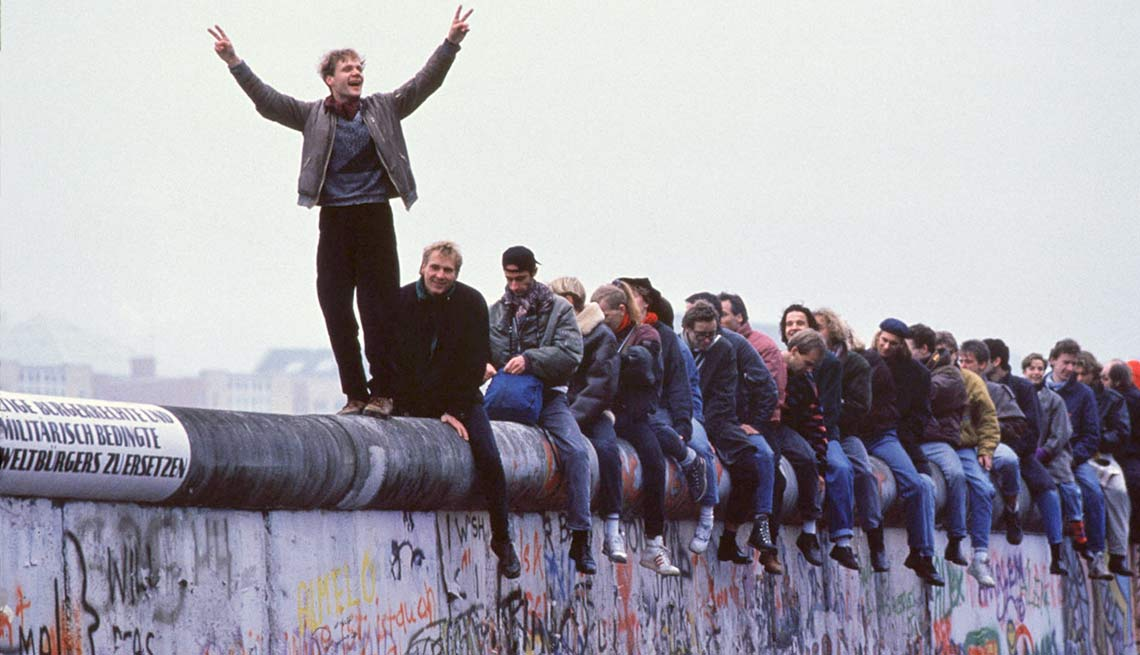
What happened next was not that the us/them filter switched off. The filter kept running with nothing external to attach to, and attached instead to the nearest available boundary — which was internal. The ‘them’ migrated inward. Within a decade the American political vocabulary had begun describing fellow citizens in terms previously reserved for foreign adversaries, and it has not stopped since. The War on Terror was framed as a replacement and failed at exactly this task, because the adversary was too diffuse to define an ‘us’ — and because the attempt added Iraq, the surveillance disclosures, and the Afghan denouement to the ledger of betrayals, so that the last shared national project ended as further evidence for the prosecution.
There is a darker half that the triumphalist account of 1991 omits. The Cold War was largely viewed as good versus evil, the godly virtuous Americans versus the sinister communists. But that container had also licensed the vindictiveness of McCarthyism, the military-industrial complex that Eisenhower warned of, and much of what led to Stage Three dissolution — COINTELPRO, MK-Ultra, the classification apparatus, and the deference of the press to the national interest. All were justified by our adversary’s existence, and most would have been unthinkable without it.
And this is more than an irony. It means the container and the betrayals were not two separate developments that happened to overlap. They were the same phenomenon. A container built on an existential adversary requires secrecy — that is what an existential adversary is for, epistemically speaking — and secrecy is exactly what made the betrayals both possible and concealable. The apparatus that kept Americans facing outward was the apparatus that let the Public Health Service run Tuskegee for forty years and the CIA dose unwitting citizens for twenty.
Which means the container carried its expiry date in its own construction. It was holding the population together while manufacturing, at a steady rate, the material that would eventually tear the population apart. Vietnam, the Pentagon Papers, and Watergate all occurred inside the container, at its height. It never stopped the hollowing. It only stopped the hollowed structure from being noticed all at once, by everyone, at the same time.
So, when the Soviet Union collapsed, the government did not dismantle the machinery the Cold War had built; it refashioned it. A country was left holding an apparatus of secrecy designed for an emergency, with no emergency to justify it, no rival whose existence had once forced its custodians to be right about something — and forty years of accumulated grievance that the container had been suppressing rather than resolving.
The Second Support: The Media Monopoly
The container’s collapse was one major domino to fall. But the establishment was still entrenched in the institutions and didn’t seem to be going anywhere in the 1970s and ’80s.
Before roughly 1990, total distrust of the American institutions might have left a citizen disillusioned but with nowhere to go. He could disbelieve the networks entirely and it changed nothing, because he had no alternative of comparable reach. Building one was not a matter of will. It required a broadcast license, a printing plant, a distribution network, a wire service, and capital in the tens of millions — which is to say it required permission from the very institutions being rejected. A dissenting faction in 1975 could produce a newsletter. It could not produce a criteria layer, because a criteria layer needs all three functions at once: something to gather knowledge upward, something to crystallize and store it, and something to carry testimony back down at scale.
The consequence is easy to state and important to sit with. Distrust in the old order terminated in cynicism or apathy, because it had nowhere else to go. The disillusioned citizen of 1978 kept watching Cronkite’s successor, kept reading the same paper, and simply believed less of it. That is a discredited stasis, but a discredited stasis is still a stasis. It is not a crisis.
The era produced its own perfect artifact of the condition. In Network, released in 1976, a fired anchorman announces on air that he intends to kill himself, and the ratings spike — whereupon the network, rather than removing him, gives him a pulpit and lets him rave. Howard Beale tells his audience to go to the window and shout that they are mad as hell and not going to take it anymore, and they do, and it is a sensation, and the network sells advertising against it. Paddy Chayefsky had seen thirty years ahead: the discovery that fury draws a crowd, and that an institution which discovers this will monetize the fury rather than answer it.
But note the part of the film that has aged into obsolescence. Beale rages from inside the network, because in 1976 there was no other transmitter. His revolt is contained by the very architecture it attacks. That is precisely the condition about to end.
Over the following thirty years, rival stacks became trivially easy to build — in four waves, the first two of which pulled the support away and the last two of which determined what would stand in its place.
The first was talk radio and cable. The repeal of the Fairness Doctrine in 1987 removed the requirement that broadcasters present contrasting views, and syndication did the rest; by the mid-1990s a substantial American audience received daily political testimony from a channel the networks did not control. Cable news followed, and by 1996 the country had competing twenty-four-hour outlets operating from different editorial premises. This was already something new — not merely more channels, but the first mass testimony flowing down from institutions outside the consensus stack.
The second was the Internet, which dropped the marginal cost of publishing to approximately zero and completed the transformation. What emerged was not noise. It was a parallel set of institutions, performing every function the original performed. It gathers knowledge upward, through crowdsourced document review, citizen investigation, and the aggregation of firsthand accounts the legacy institutions would not run. It crystallizes and stores, in archives, canonical episodes, reference figures, and a shared canon of events everyone inside it knows. And it carries testimony downward at a scale that rivals the networks at their peak.
This was, and remains, a liberation as well as a catastrophe, and an honest account has to hold both. The same collapse that destroyed the gate destroyed the gate’s power to bury a story — a substantial share of what we cover in this study reached the public through channels no gatekeeper controlled. But the asymmetry is stark. The old system enforced criteria, adjudicated, and at least paid lip service to the objective truth. But then one arrow became a million arrows, and not one of them inherited the obligation the first one had carried.
The third was the social media platform, which did something worse than permit the split: It performed the sorting automatically. An editor choosing a front page was applying a criterion — a bad one, often, and a self-interested one, but a criterion in the technical sense: a standing answer to what should the public be told. Whatever else it tracked, it was in the neighborhood of importance and accuracy, because those were the terms in which the profession judged itself. The platforms that consolidated after 2007 replaced that with something structurally different. They are engagement machines, paid in attention rather than accuracy, and an engagement machine does not decide to prefer outrage to correction or certainty to nuance. It discovers those preferences empirically, at a scale no editor could match, and applies them to billions of people. Which means the citizen no longer chooses his stack. He is assigned to one, by a system that has established through experiment which stack will hold his attention longest. The echo chamber is not a place a person walks into. It is a place built around him while he sits still.
And, finally, the fourth wave of generative AI has arisen in the last five years or so, promising to change not only the institutions but how we come to know at all. For a century and a half, photography and audio recording functioned as something close to testimony without a live witness — instruments whose competence was physics and whose sincerity could be presumed, because faking them convincingly was expensive and difficult. That presumption was essential for courts, journalism, history, and ordinary life, and it worked because such recordings sat at the junction of the model’s two halves: they came down the testimony channel while carrying the evidential weight of something that had come up through perception. Generative systems revoke it all, and the damage runs both ways. Fabricated material can be believed. And — the more corrosive effect — authentic material can now be dismissed by anyone who finds it inconvenient.
The Vacuum
Within the space of a decade, both supports were gone.
The adversary that had unified the West ceased to exist in 1991, taking with it the external boundary that had kept the us/them filter pointed outward. And the monopoly that had made the institutions the only available source of that picture was dismantled between 1987 and the late nineties, so that for the first time in the modern era a citizen who disbelieved the networks had somewhere else to look.
Neither loss had anything to do with the betrayals. One was a geopolitical event and the other a technological and regulatory one, and both would have happened had every American institution behaved impeccably for fifty years. But they arrived on a structure that had already been hollowed, and they removed the only two things holding it upright.
What was left is best described precisely, in the terms of the model.
In stasis there is one stack: one set of institutions, one adjudication, one testimony channel feeding one population. Disputes are fierce and constant, but they have a venue, and the venue’s rulings are accepted even by the parties who lose — which is the whole definition of a functioning criteria layer, and the reason a country can contain vehement disagreement without falling apart.
What remained after 1991 was not a damaged version of that. The buildings still stood; the agencies still issued findings; the journals still published; the anchors still read the news at six-thirty. What had broken was the stack’s capacity to serve — to settle a question in a way that both parties would accept. An establishment nobody credits is not a criteria layer. It is a shell.
And the population confronting that shell was, by now, overwhelmingly in Stage Three. Not a fringe and not a faction: a majority, distributed across every demographic, holding as a settled conclusion that the people running the institutions could not be relied upon to tell them the truth. That is not a mood or a grievance. It is the operating condition of a country without a shared court, and it is measurable.
To see the dissolution in chart form, simply regard The General Social Survey, which has asked Americans the same question since 1972: How much confidence do you have in the people running each of these institutions? Plot the answers by generation across half a century and the completed condition becomes tangible as a sinking stone.
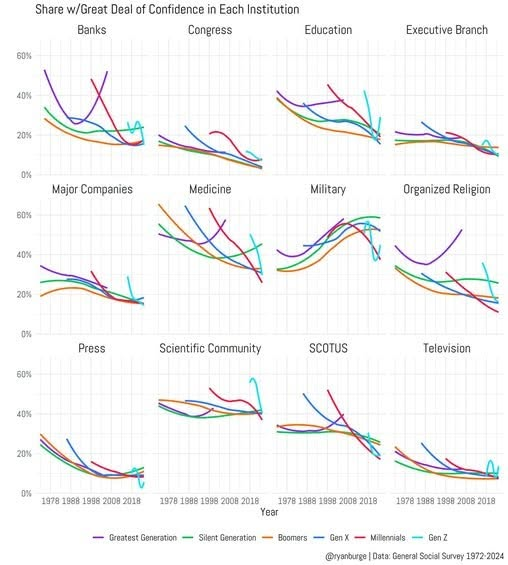
Four things in that picture are worth pausing over.
The decline is nearly universal. Education, medicine, the press, television, organized religion, Congress, the executive branch, major companies, banks, the Supreme Court — the lines run down and to the right in every panel but one. This is not a story about one discredited profession. It is the criteria layer as a whole losing its standing, which is precisely what distinguishes an epistemological crisis from an ordinary scandal.
The exception proves the rule. Confidence in the military rose — from roughly a third in the late 1970s to nearly sixty percent at its peak — before slipping again after about 2015. This is doubtless a reflection of the public attempt to repair past injustices levied on the military after Vietnam. But it is also indicative of a broader truth: The military is the one major institution in the list that does not adjudicate public truth claims. And an institution that is not in the knowledge business does not suffer a knowledge crisis. It is judged on whether it wins, which is increasingly important in an age of intensifying division.
Each generation starts lower than the last. Look at where each cohort’s line begins rather than where it ends. On institution after institution, Boomers enter the data below the Silent Generation, Gen X below Boomers, Millennials below Gen X. This is the finding that forecloses the comfortable assumption that the mood will pass. The trust is not being lost by people who once had it and might recover it. It is not being transmitted. A generation that never extended the default cannot withdraw it, and cannot be talked back into it either.
And the fourth finding points to a key insight that underscores the entire argument. Look at the panel for the scientific community — and then at the panel for medicine. Confidence in the scientific community is close to flat. It sits around 40 to 45 percent for half a century and does not collapse. Meanwhile, confidence in medicine falls off a cliff, from around sixty percent in the late 1970s to something in the 20s and 30s.
Those two panels, side by side, are the motte and the bailey rendered as data. Americans did not stop believing in science. They did not decide that evidence is a myth or that reason is a tool of oppression, whatever the doctrines described in the next section may hold. What collapsed was confidence in the people running the institutions that speak in science’s name — which is exactly what the survey question asks about, and exactly the distinction that every public campaign of the last decade has worked to erase. ‘Trust the science!’ was addressed to a population that still trusted science and no longer trusted the messenger, and it was phrased, with remarkable precision, so as to make that distinction impossible to state.
The press and television panels are the other end of the same finding: both fall below ten percent, the lowest in the chart. The institutions whose sole function is to carry testimony are the institutions least believed.
Multiplicity
Both supports had held the same thing in place: not belief in the institutions, which was long gone, but the impossibility of organizing without them. Remove the supports and that impossibility lifts — and what follows is not a vacuum patiently awaiting an occupant. It is proliferation.
The container’s collapse determined where the new lines would fall. The us/them filter kept running with nothing external to attach to, so it attached to whatever boundaries lay nearest, and there were a great many of them. Democrat and Republican, of course — but that was only the coarsest cut, and by no means the most operative. Liberal and conservative, which is not the same division and increasingly does not map onto the first. White and minority. Men and women. Coastal and heartland. College educated and not. Credentialed and uncredentialed, which by the 2010s had become the single sharpest predictor of which account of an event a person would accept. Vaxxed and unvaxxed. Normie and conspiracy theorist — a pair worth noticing, because unlike the others it is not a division over policy or interest but a division over epistemology itself, an explicit sorting of the population by which method of knowing it credits. And beneath those, thousands of finer cuts, each with its own membership and its own heresies.
The monopoly’s collapse determined what could be built behind each of those lines. For the first time, a Stage Three citizen could locate the others, assemble a shared canon, and construct something performing all three functions of a criteria layer — gathering knowledge upward, crystallizing and storing it, carrying testimony back down at scale.
Put the two together and the result is not a replacement stack. It is a swarm of them.
The diagram in Section II shows two in its crisis panel, and two is the right number for a picture that has to stay legible. The actual condition is worse. What emerged was a proliferation of partial criteria layers — each with its own experts, its own archive, its own canon of settled questions and disqualifying heresies, each authoritative to its adherents and invisible or contemptible to everyone else. There is a stack for which the pandemic response was broadly sound and its critics were cranks, and a stack for which it was a criminal conspiracy. There is a stack in which the 2020 election was the most secure in American history and a stack in which it was stolen. There are stacks organized around a podcast, a substack, a denomination, a diagnosis.
And notice why fragmentation is worse than opposition. Two rival stacks can at least negotiate — two blocs with distinct institutions can send delegations, strike bargains, and recognize each other as adversaries with standing, which is what the international system does and what a two-party system used to do. A hundred fragments cannot. There is no delegation to send. There is nobody with the authority to make an agreement stick, because authority is precisely the thing that dissolved. What replaced the single stack is not a rival order but a condition of permanent unresolvability, in which every question can be answered confidently by someone and settled by no one.
The 77 percent was gone, and it was not coming back, and no exhortation about trusting the experts could possibly retrieve it, because the people had not made an error. They had learned.
One American had seen the shape of it coming, and left behind the best description we have of what such a transition feels like from inside.
In 1900 Henry Adams walked into the Gallery of Machines at the Paris Exposition and stood before the great dynamos, and found that he could not think about them. He had spent years on the medieval world, on Chartres and Mont-Saint-Michel, and had concluded that the Virgin was the most powerful force the West ever generated — a single organizing principle that raised cathedrals out of a poor and violent continent. Now here was another force, plainly enormous, and he could find no scale on which to compare the two. All the steam in the world could not, like the Virgin, build Chartres. But the dynamo was doing something the Virgin could not, and there existed no unit in which to state the difference.
Adams framed the problem as the passage from unity to multiplicity, and made it the organizing theme of two books — the thirteenth century that had one principle, and the twentieth that had a proliferating set of forces answerable to nothing above them. He thought this a law, and expected acceleration.
Whether he was right is not obvious. Such fragmentation may be a law of history, working itself out on a schedule no one chose, or it may be the contingent product of identifiable failures and therefore in principle reversible. What cannot be doubted is that the predicament Adams faced in that machine hall is the crisis in miniature. A serious man, standing between two real things, unable to find a common measure by which either could be judged against the other. He had the evidence. He lacked the criterion.
A century later a whole country would find itself in the same room. But by then the problem was no longer two great forces without a scale between them. It was a million tiny pieces, each with its own adherents, and each insisting the scale was theirs.
This is part of a series of essays that examine the current epistemological crisis.
PART I: The Fauci Affair and Our Epistemological Crisis
PART II: A Theory of Epistemological Stasis and Crisis
PART III: How We Got Here: The Hollow Stasis
PART IV: The Long Dissolution
PART V: Childhood Vaccines: A Case Study in Epistemological Dissolution
PART VI: A Million Tiny Pieces: Descent into Epistemological Crisis