The Long Dissolution
This is part of a series of essays that examine the current epistemological crisis.
PART I: The Fauci Affair and Our Epistemological Crisis
PART II: A Theory of Epistemological Stasis and Crisis
PART III: How We Got Here: The Hollow Stasis
PART IV: The Long Dissolution
What followed next on that weakened structure was a piece-by-piece dismantling of the trust and confidence that centuries of industrial and geopolitical success had wrought. The dominant mood was betrayal, and it is the most prominent aspect of the period, because it was administered in doses across half a century — each dose defeating the trust defaults of one or another custodian, and each landing on a public that had been taught, by everything in their experience, to expect better.
The 1964 poll that had revealed that more than three quarters of Americans said the federal government could be trusted to do the right thing was not naivety; it was an inference from evidence, drawn by people who had watched the same institutions win a world war, abolish polio, and put fresh bread on the table. The confidence was earned.
But the institutions that earned it were, by then, no longer the institutions that had earned it. They had grown — vastly, and for the best of reasons — and in growing they had acquired every pathology of a mature stasis: verification replaced by proxy, judgment replaced by counting, scale past the point where anyone inside could check anything. And a large apparatus running on inertia does not stop producing. It goes on producing with the same confidence and less of the underlying work, which means the ratio of miracles to mistakes quietly shifts, and nobody inside notices, because nobody inside is checking. The bomb and the vaccine were the products of a small, hungry, self-auditing enterprise. What followed came out of something much bigger and much less vigilant.
A crisis begins when the testimony coming down from the institutions stops matching the experience and reason coming up from reality. But that mismatch does not arrive all at once. It arrives as anomalies — one at a time, each individually explicable — and what determines whether a culture survives them is not how many there are. It is what the institutions do with them.
There are three options, and they correspond to three stages of dissolution.
In the first, the anomaly is absorbed. Something goes wrong; the machinery notices; it adjudicates, and either the anomaly is explained and corrected or the scheme is revised to include it. The system visibly works. The citizen watching concludes: ‘They made a mistake, and they fixed it.’
In the second, the pattern is conceded. The anomalies mount, and it emerges that they were never anomalies at all — they were products of the system, known and concealed. This is a far harder demand, because it requires the institution to change rather than merely absorb. And for a long time the institutions met it: The concealment was broken, the machinery responded, laws were rewritten, substances were banned. The citizen concludes: ‘They knew, and they hid it, and they were caught, and they finally changed when they had to.’
In the third, the channel is severed. The institution encounters an anomaly it cannot reconcile without destroying itself — and stops adjudicating. It fights the anomaly instead. The upward flow of knowledge is cut, inconvenient findings are not incorporated but suppressed, and the people producing them are not answered but removed. And what continues to flow downward is no longer testimony in any meaningful sense. It is propaganda, which is the name for what comes down a channel that has stopped being fed from below. The citizen concludes: ‘They are lying, and they will not stop.’ Recall the reflection of Soviet tyranny by Elena Gorokhova: “The rules are simple: they lie to us, we know they’re lying, they know we know they’re lying, but they keep lying anyway, and we keep pretending to believe them.”
That third stage is precisely the crisis panel of the diagram: The Science and Record arrows severed, the Testimony arrow still running at full volume, carrying something that no longer has any connection to the ground.
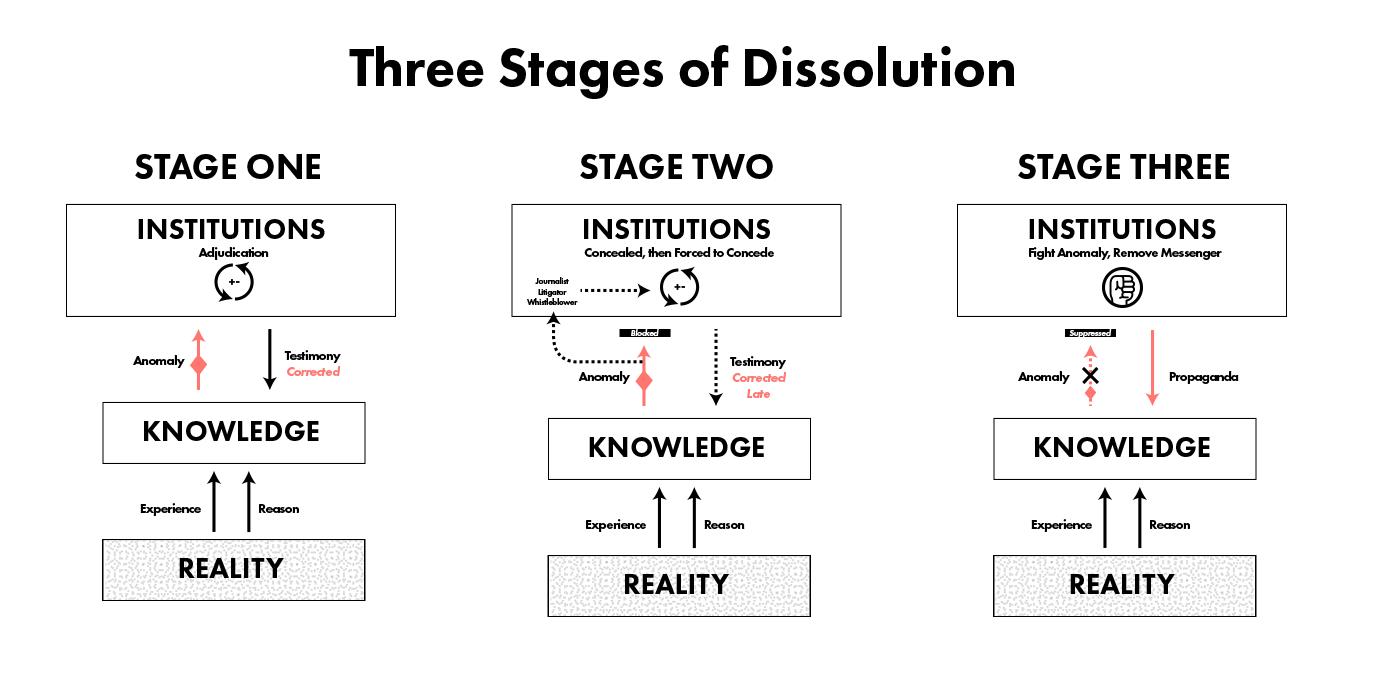
These three stages are not periods of history. They are positions a person can occupy, they overlap, and they run at different speeds in different people — which is why the sequence below is not strictly chronological. But they are steps in a process, and the movement runs one way. Nobody who has arrived at the third goes back to the first. Once one reaches the third, crisis is imminent.
Stage One: Anomalies Absorbed
The first failures arrived as exceptions — shocking, well-reported, and apparently rare. And the institutions’ response was, on the whole, the response the public expected: The anomalies were absorbed not by explaining them away but by building an organ that had not existed before, which is Stage One at its most impressive and is how much of the mid-century apparatus came to exist in the first place.
The pattern is already fully formed in the 1930s, before the stasis had even reached its height. In 1933 two engineers from a small product-testing outfit, Arthur Kallet and F. J. Schlink, published 100,000,000 Guinea Pigs: Dangers in Everyday Foods, Drugs, and Cosmetics, and it became a national bestseller on the strength of one argument: that Americans were serving, without their knowledge or consent, as test subjects for products nobody had established were safe. The law then in force, the 1906 Pure Food and Drug Act, prohibited false claims on a label — and therefore did nothing at all about a product that made no claims and listed no ingredients. No manufacturer was required to demonstrate that anything he sold was safe before selling it.
The grievances behind the book were concrete, and they spawned an entire genre within four years. An eyelash dye called Lash Lure was blinding women. Radium had been painted onto watch dials by young women who pointed their brushes with their lips, while the company’s own chemists handled the same material behind lead screens. Lead arsenate residues on American fruit had become a diplomatic embarrassment abroad. The FDA’s response to the mounting pressure was to assemble a traveling exhibit of maimed and poisoned consumers that a reporter christened ‘The American Chamber of Horrors’.
Medicine’s own failures in the decade were of precisely the same kind. In November 1935, at the annual meeting of the American Public Health Association, two research teams presented polio vaccines they had already administered to children — John Kolmer of Temple had given an attenuated live-virus preparation to roughly ten thousand of them, and Maurice Brodie of New York University a formalin-inactivated one to several thousand more. Neither had done adequate animal work; neither had controls. Children were paralyzed and children died, the count usually given being six dead and ten paralyzed. The profession’s reaction was public and savage — a Public Health Service officer denounced both men from the floor, and Kolmer is reported to have said that he wished the floor would open and swallow him. Polio vaccine research was set back some twenty years, and Brodie, finished, was dead within four.
Then in 1937 a Tennessee firm dissolved a new sulfa drug in diethylene glycol — industrial antifreeze — bottled it as Elixir Sulfanilamide, and killed 107 people, most of them children. It had broken no law, because no law required the manufacturer to test anything.
And the system absorbed all of it, in the most consequential way available: by growing a new organ. The Federal Food, Drug, and Cosmetic Act of 1938 required, for the first time in American history, that a manufacturer demonstrate a product’s safety before selling it, and extended federal authority over cosmetics and devices. Vaccine licensing tightened. Consumers Union was founded in 1936 to publish independent product testing. Elixir Sulfanilamide did not happen again.
This matters more than it first appears, because it means the apparatus the postwar generation trusted so completely was not an ancient inheritance. It was a recent repair, built within living memory by people who had just watched an unregulated market blind, poison, and paralyze its customers — and the trust it commanded was earned, because the repair worked. Whatever else the seventy-seven percent was, it was not naivety.
But notice what a citizen paying attention had already learned. The things modern industry was selling him — the medicine, the cosmetic, the sprayed apple, the vaccine — might be hurting him and his children, and until very recently nobody at all had been checking. The remedy was real. The lesson underneath it did not go away.
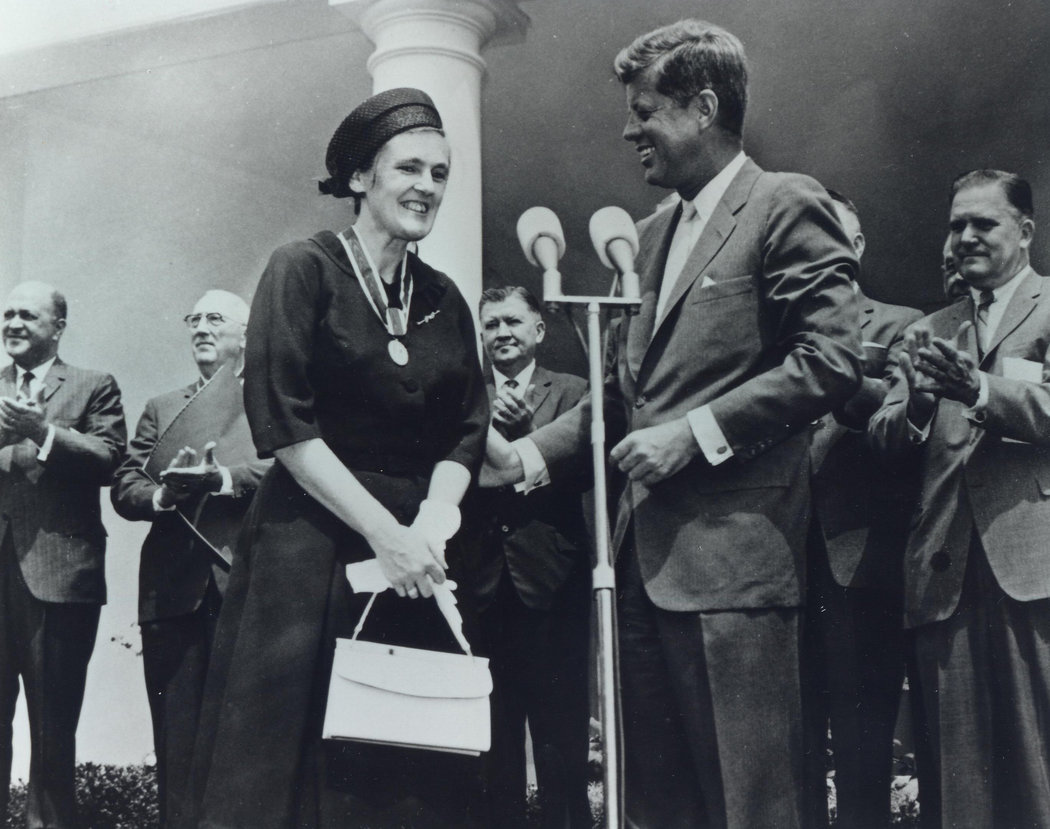
In the 1960s, this new lesson was put to the test. Thalidomide had been given to pregnant women across Europe as a mild sedative, like the then-popular Librium, and their children were born without limbs — some ten thousand of them. The American chapter makes you catch your breath: A single FDA reviewer, Frances Kelsey, had refused to approve the drug, citing a lack of evidence of the drug’s safety, and absorbed a year of industry pressure for it. After the news divulged the tragedy, President Kennedy pinned a medal on Kelsey that August. But read what the public actually took from the episode. The system had worked because one stubborn woman happened to be standing in the right doorway. Had she been on leave, the babies would have been American. That is not a reassuring thought, and it was not received as one; Congress rewrote the drug laws within months.
But sit for a moment with what that did to a country in the middle of the Wonder Years. The postwar bargain, as we saw, rested on a stream of daily evidence that the men in white coats delivered: the antibiotic, the vaccine, the fluffy bread, the shake without ice cream. Every new product was a small proof of the arrangement. And now here was a new product — modern, tested, prescribed by doctors, developed by a reputable pharmaceutical company, and marketed as safe enough for pregnant women — that had maimed a generation of European children.
The lesson was not that regulators can be careless. The lesson was far larger and far more disturbing: The things the institutions are producing might not be wonders after all. They might actually be harmful. For a culture whose entire trust was built on the reliability of what came out of the laboratory, that is a crack in the foundation holding up the entire modern project.
Most people did what people do with a realization of that scope. They put it aside. It was one drug, it was stopped, and there was a medal to prove the system worked. But a few did not put it aside, and from 1962 forward there existed in America a small population of people who had understood something the majority had declined to understand — and who would be proved right again, and again, and again, for sixty years, all the while being called cranks the entire time. The seed of every later skepticism is planted here, in the correct reading of a story that was touted as a success of the system.
In the autumn of that same year, Rachel Carson published Silent Spring, which argued that chemical pesticides, and particularly DDT, had not only done what they said they did — protect crops from damaging pests — but that it had the unintended consequences of also altering the ecosystem, harming the wildlife and ultimately humans. The chemical industry’s coordinated campaign to portray a distinguished biologist as a hysteric was conducted in public and became the blueprint for later such attacks. DDT was withdrawn a decade later, and the withdrawal is still debated today. What is not arguable is the lesson taught: The men who assured you a compound was harmless were prepared to attack the woman who asked.
Clean Air was the clearest Stage One success of all. In 1948 a temperature inversion trapped industrial emissions over Donora, Pennsylvania, and killed twenty people in three days; London’s Great Smog of 1952 killed thousands; Los Angeles spent the ’50s and ’60s under a haze that stung the eyes of schoolchildren. This was an anomaly nobody could deny, because everyone could see it — the two lower arrows of the diagram, delivering evidence directly to every citizen with lungs. The institutions adjudicated. The Clean Air Act was passed and then strengthened, the catalytic converter was mandated, lead was ordered out of gasoline, and the air over American cities measurably, visibly cleared. A person who grew up in Pasadena in 1965 and returned in 1995 could confirm the result himself, without having to trust any expert. That is the machinery working exactly as advertised, and it is worth stating plainly, because it is the strongest single answer to anyone who reads this essay as an argument that expertise never delivers.
Other cases fit the same shape. The ozone hole was discovered by chemists, and the compounds their own profession had celebrated were phased out by international treaty within thirteen years of the paper that indicted them. Similarly, RotaShield, a rotavirus vaccine licensed in 1998, was pulled within a year after a signal for intussusception appeared — roughly one case in ten thousand, caught by surveillance and acted upon.
And in 1976 came an episode almost nobody remembers and everyone should. Fearing a repeat of 1918, the federal government mounted a mass immunization campaign against a swine flu pandemic that never arrived. Some forty-five million Americans were vaccinated in ten weeks. But then several cases of Guillain-Barré syndrome appeared, the program was suspended in December, and the government spent years litigating claims. Though the program was stopped — a Stage One ending — the episode taught a lesson that Americans have been wrestling with for the following five decades: that large-scale scientific-industrial efforts, even when they are geared to the health and safety of the people, can be misguided and end up hurting us more in the end, a lesson that shaped the entire medical industry in the decades that followed.
Here is the thing the custodians never reckoned with, and it applies to every case in this stage. The distinction that matters to a scientist or medical professional does not survive contact with a kitchen table. From inside the profession, ‘We found our own mistake and corrected it’ is a story of institutional health. But, from outside it reads: ‘They told us it was safe, they were wrong, our children were harmed, and we found out afterward.’ Run that lesson through twenty years of headlines and an entirely rational citizen arrives at a conclusion nobody intended to teach him — that a current assurance of safety is not evidence of safety. He is not being paranoid. He is generalizing correctly from a long run of data supplied by the institutions themselves.
And that generalization is the doorway from Stage One to Stage Two.
Stage Two: The Pattern Conceded
Then came the cases where the harm had not been stopped before it was too late. It had been known early and concealed by the parties who profited — with the regulator sitting on the same side of the table. And in each of them the concealment eventually failed, the truth came out, and only then was something done. That combination is what defines the second stage: The institutions are corrupt, but they are still corrigible.
Tetraethyl lead is the type specimen. Workers were dying and hallucinating on a Standard Oil production line in 1924, three years after the additive was introduced. The industry’s answer was to fund the science itself, and Robert Kehoe, whose laboratory was paid for by the lead interests, established the rule that would govern American regulation for four decades: The burden of proof lies on whoever alleges harm. It took Clair Patterson, a geochemist who had stumbled onto the contamination while trying to date the age of the earth, to break the paradigm in the 1960s, and he was punished for it with lost contracts and lost committee seats. Lead was not taken out of American gasoline completely until 1996. It is now understood to have cost a measurable share of the cognitive capacity of everyone raised in the twentieth century.
Several other examples dot the record of the period:
Manufacturers of asbestos had the medical literature in the 1930s and said nothing for forty years; their internal correspondence surfacing in litigation in 1977.
The tobacco industry, in a 1969 internal memo, set out the method with a candor that has become the era’s motto — doubt is the product, because doubt is the best means of competing with a body of fact — and its chief executives still swore before Congress in 1994 that nicotine was not addictive, four years before their own documents were released to prove otherwise.
The sugar industry quietly paid Harvard researchers in the 1960s to steer blame for heart disease toward dietary fat, a redirection that shaped fifty years of nutritional advice, though no one knew it until documents surfaced in 2016.
The chemical companies’ own studies of the persistent compounds now called PFAS sat in internal archives while the substances went into cookware, carpets, and drinking water.
DES, a synthetic estrogen prescribed to millions of pregnant women for two decades, was deprecated when their daughters began presenting in 1971 with a rare vaginal cancer.
The Dalkon Shield was pulled in 1974 after septic abortions and deaths.
Love Canal toxic waste scandal was brought to light in 1978 after half a century of deleterious effects.
The Agent Orange litigation of the 1980s, in which veterans of an American war spent a decade being told by their own government that what had happened to them had not happened.
Vioxx was withdrawn in 2004 after an estimated tens of thousands of excess heart attacks.
A pharmaceutical company marketed an opioid as minimally addictive, pleaded guilty to criminal misbranding in 2007, and paid a fine that a subsequent generation of overdose deaths made look like a licensing fee.
Several catastrophic failures of prevention belong here too, because they follow the same arc: The custodians failed at their first duty, and only after the failure did the machinery investigate itself in public and publish what it found.
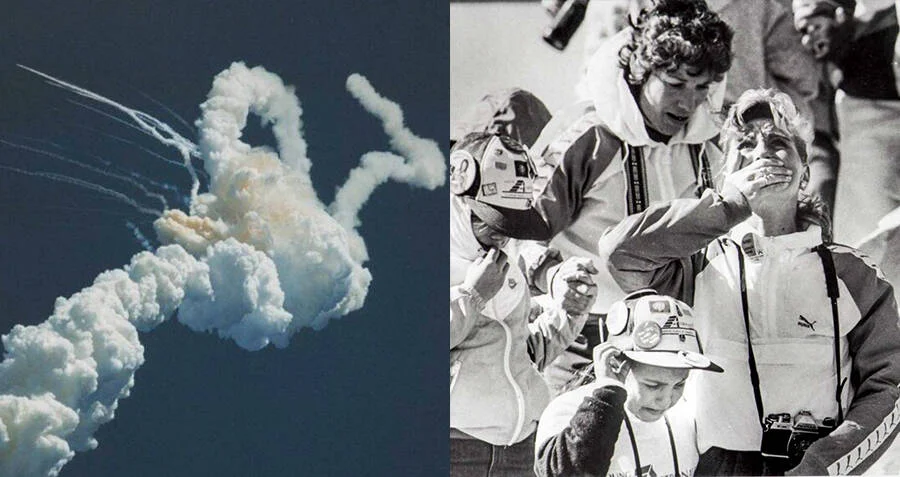
The Challenger explosion of 1986 — watched live by schoolchildren to see the first teacher in space — proved on investigation to be a parable of performed certainty: NASA’s managers had launched despite their own engineers’ objections about the cold temperatures and the brittleness of the O-rings. The Rogers Commission’s Richard Feynman threatened to remove his name from the report unless his own observations were included, and then closed his appendix with a sentence that belongs at the bottom of the epistemological model: “For a successful technology, reality must take precedence over public relations, for nature cannot be fooled.”
September 11 was the same parable at civilizational scale — the security apparatus missing the attack its entire existence was justified by, even though “The system was blinking red”, in the 9/11 Commission’s phrase. And its aftermath is the most instructive datum in the series: Trust rallied, surging to a three-decade high in the weeks after the attacks, because a frightened public reflexively extends the default one more time. Then the intelligence custodians spent the entire rally on Iraq: the machinery of certified knowing, at maximum solemnity, delivering a false positive that cost a trillion dollars and hundreds of thousands of lives. Twenty years of regime-change nation-building in Afghanistan ended with a government that evaporated in eleven days, having been described as viable in official assessments until nearly the last week.
The economic custodians took their turn in 2008, when the credentialed consensus failed to see the largest financial meltdown of the era coming and then arranged for its costs to fall on the public that had trusted it — and it is worth noticing that the Tea Party and Occupy Wall Street were twin abductions from a single betrayal, two tribes drawing opposite lessons from the same betrayal, a preview in miniature of everything that came later.
Every one of those produced a commission, a report, and a public accounting. That is Stage Two functioning. But notice the crack opening inside it, because it is the crack through which the third stage arrives: In the later cases, the accounting produced no consequence. Nobody was demoted for Iraq. Nobody was prosecuted for 2008. The machinery adjudicated, but then nothing followed from the adjudication — which teaches the public that the adjudication itself has become a show, a ritual performed in place of a remedy.
The optimists note what held in this stage: In every one of these cases, the concealment was eventually broken — by a journalist, by a litigator, by a scientist who would not be quiet — and the machinery responded. They took lead out of gasoline. Asbestos was banned. The tobacco companies eventually paid. That is a corrupt system, but a correctable one, and a person who believes his institutions are correctable is still, in the sense that matters, inside the stasis.
The pessimist will counter that these cases show how pervasive the corruption really is and how scarce the potential safeguard. The increasing complexity of the system and the inherent upper hand given to the powerful few running the institutions mean that whatever hope we can claim for corrective is quickly evaporating. Even the corrective seems to be compromised these days.
Consider the Climate Change movement as the quintessential example. The clean-air victory of the 1960s and the climate controversy of the last three decades emerged from the same environmental-science apparatus, and they could hardly be more different epistemically. Smog was verified by anyone with eyes; the intervention was specific; and the result was visible within a decade. Climate is the opposite on every axis: The system is planetary, the timescale is generational, the key projections are model-based, and no individual has verified anything at all. Which means it was the first great corrective in which the public was told to ignore their experience and reason and simply rely on the testimony from the institutions which were said to have caused the crisis in the first place.
The author does not presume to be able to adjudicate the science here. What is worth marking is the epistemic form the controversy took, because it is the form we have been tracing in this study. Dissent was met not with argument but with a slur — ‘denier’ — a word borrowed with deliberate malice from Holocaust denial, which is moralization in its purest and most efficient form. Grant funding flowed toward alarm and away from moderation, in exactly the manner described above. And when the Climategate emails surfaced in 2009, they showed working scientists discussing how to keep contrarian papers out of journals and how to handle awkward data — behavior which confirmed for anyone already at Stage Two precisely what they suspected about how consensus gets maintained.
To the lay observer, concerned about reports of rising temperatures, the entire enterprise might be justified. But who can deny the celebrity private jet conferences to end Global Warming and the never ending supply of completely wrong models makes the science look like a scam. Whatever one concludes about the climate, it is hard to deny that the alarmism and activism played out like a rehearsal.
Stage Three: The Channel Severed
At 1:23 in the morning of April 26, 1986, the fourth reactor at the Chernobyl Nuclear Power Plant exploded. What followed is the purest specimen of epistemological failure in the twentieth century, and almost none of the damage was radiological.
The plant’s own operators could not report what had happened, because their instruments did not read that high and the possibility was not in the manual. Local officials reported upward what their superiors could tolerate hearing. Moscow said nothing. The world learned of the accident two days later, when monitoring stations at a Swedish nuclear plant six hundred miles away detected the plume and officials in Sweden began asking questions. Pripyat, a city of fifty thousand at the plant’s fence line, was not evacuated for thirty-six hours; its children played outside under a sky that residents described as beautifully iridescent. Five days after the explosion, the May Day parades went ahead in Kyiv, with schoolchildren marching through the streets, because cancelling them would have signaled that something was wrong.
Every layer of the diagram failed in sequence. The upward channels were severed — measurement, report, and record all stopped carrying, not because the instruments broke but because the information was unwelcome. Adjudication did not occur; there was no venue in which a technician’s reading could overrule a ministry’s preference. And the downward channel ran at full volume, carrying reassurance, which is the precise definition of propaganda: testimony from an institution that has stopped listening to reality.
Gorbachev would later say that Chernobyl, more than Afghanistan or the economy, was what destroyed the Soviet Union. He was making an epistemic point. A state that cannot let bad news travel upward cannot correct itself, and a state that cannot correct itself cannot survive contact with a physical world that does not care what the ministry preferred.
And here is where an American reader is invited to feel entirely safe, and should not. The obvious lesson of Chernobyl is that this is what totalitarianism does — that a free press, an independent judiciary, and a scientific community not answerable to a party are precisely the machinery that prevents it. That lesson is true. It is also the reason the American cases are so much more disturbing than they look, because the United States has done versions of all of it, with the supposedly free press and the theoretically independent judiciary fully operational, and got away with it for decades.
In March 1971, activists burgled an FBI office in Media, Pennsylvania, and exposed COINTELPRO — a fifteen-year program of surveillance, infiltration, and sabotage against domestic political movements, which had included mailing Martin Luther King Jr. an anonymous letter urging him to kill himself. In July 1972, an Associated Press reporter, acting on a whistleblower’s evidence, revealed that the United States Public Health Service had spent forty years studying the progression of untreated syphilis in six hundred poor Black men in Macon County, Alabama — men who were told they were being treated for “bad blood,” who were never told what they had, and from whom penicillin was deliberately withheld for a quarter century after it became the standard cure. Then the Church Committee hearings of 1975 and the Senate hearings of 1977 disgorged MK-Ultra: two decades of CIA experiments in behavior modification, including LSD administered to unwitting subjects, conducted through some eighty institutions and dozens of universities and hospitals, often routed through front foundations so that the researchers themselves did not know who was paying. One army scientist, dosed without his knowledge, went out a New York hotel window; his family was told it was suicide and learned otherwise twenty-two years later.
Look at the structure rather than the content, and the parallel to Pripyat is exact. In each case the upward channel was severed at the source — the subjects did not know, the researchers did not know, the oversight bodies did not know. In each case the downward channel continued to carry assurance. And in each case the concealment held not for thirty-six hours but for decades, and was broken not by any internal mechanism but by a burglary, a whistleblower, and a filing error.
Alongside them ran the political sequence. Vietnam and the Pentagon Papers established that successive administrations had lied systematically about a war while it was killing American teenagers. Watergate established that a president would do it about a burglary.
And the assassinations, which are the true hinge between the second stage and the third. President Kennedy was killed in 1963, his brother and Martin Luther King Jr. within eight weeks of each other in 1968, and the official account of the first was delivered by the Warren Commission in 1964. It was widely accepted at the time — a Stage Two event, in which the machinery convenes, investigates, and publishes. Then, over the following decade, the account eroded: The film the public had not been permitted to see was broadcast at last in 1975; it emerged that the FBI and CIA had withheld material from the commission; and a House select committee concluded at the end of the 1970s that there had probably been a conspiracy after all.
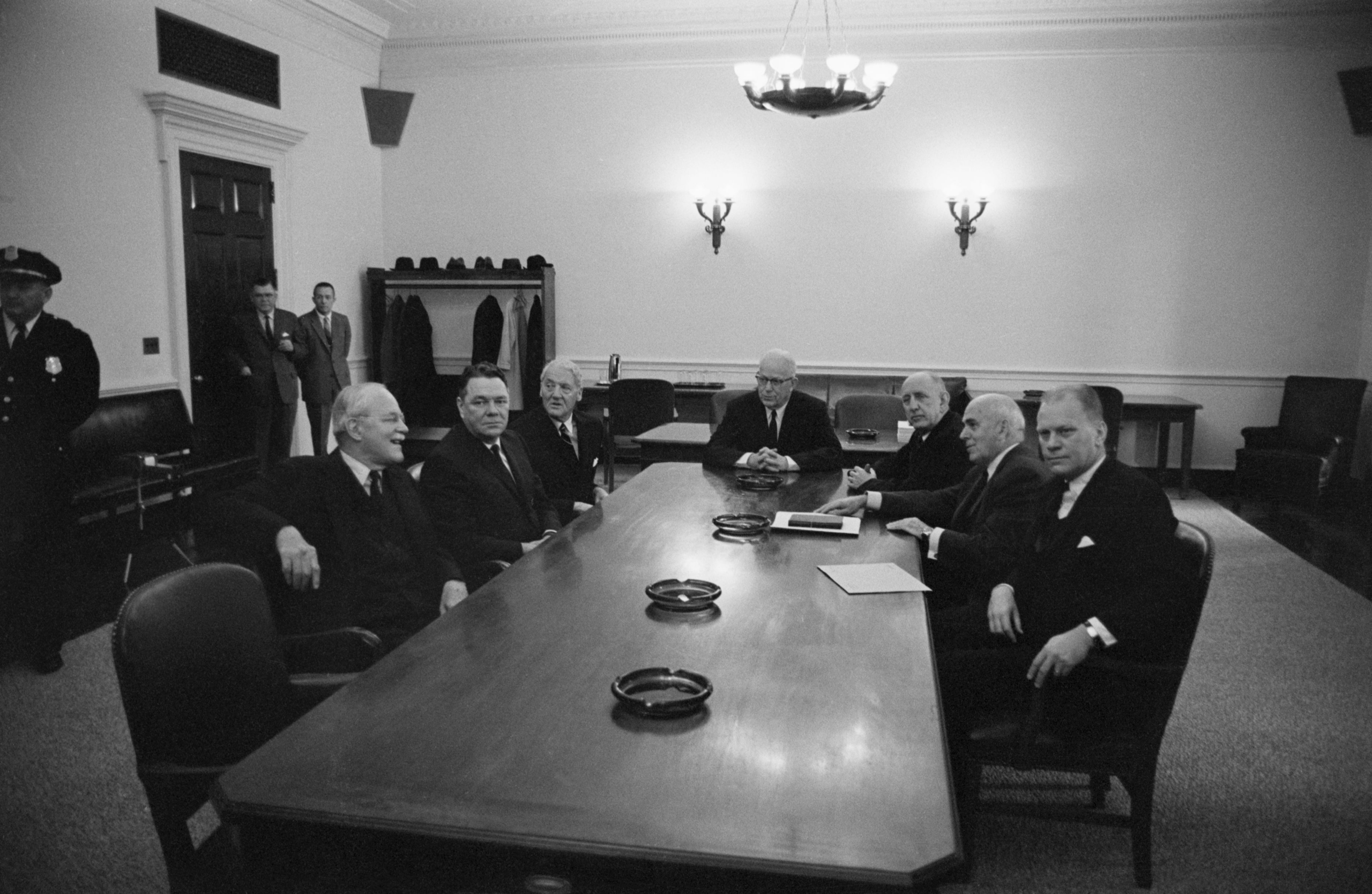
Whatever one believes about Dallas, that sequence did something to the American mind that no single revelation could have done. It did not merely produce doubt about an event. It produced doubt about the adjudication of the event — which means it retroactively converted a Stage Two proceeding into a Stage Three one, and taught a generation that a commission of the great and good is a thing that can be run on incomplete information supplied by interested parties. Once that lesson is learned, it cannot be confined to one commission.
The Architecture of Secrecy — and the Re-reading of Everything
Underneath all of it sits a structural fact rarely examined: A modern state maintains an enormous body of information that it declines, as a matter of routine, to let its citizens see.
Formal classification is not ancient. It grew out of the First World War, was systematized by executive order during the Second, and then — crucially — was extended to civilian agencies in the early 1950s, so that a wartime expedient became a permanent feature of peacetime government. There is no general statute establishing it. As the Moynihan Commission observed in 1997, the entire regime has flourished on executive authority alone, and its scale is difficult to comprehend: two million officials and a million contractors with the power to classify; some 92 million classification decisions in a single recent year; nearly 50 million documents classified in 2017 at a cost above $18 billion. Officials have been conceding for seventy years that most of it is unnecessary — a 1956 report noted the tendency to play safe, a former National Security Council executive secretary estimated that only a tenth of classification protected genuine secrets, and a chairman of the House Intelligence Committee told the 9/11 Commission flatly that the government overclassifies very badly.
And note how the public learned what any of it contained. The Freedom of Information Act passed in 1966 and acquired teeth only in 1974, over a presidential veto, in the wake of Watergate. The Pentagon Papers were published because a man photocopied them. COINTELPRO surfaced because activists burgled an FBI office. MK-Ultra survives in the record only because a clerk had misfiled twenty thousand pages in a financial-records warehouse after the director ordered the files destroyed. The assassination files were placed under a statutory release schedule in 1992 and were still emerging, in tranches, more than thirty years later. In each case the citizen’s first lesson was not the content. It was the discovery that the file had existed all along.
Moynihan’s commission put the epistemic point exactly. Secrecy, it found, is a form of regulation — and the ultimate one, since the citizen does not even know that he is being regulated. That is precisely the condition this essay describes: an institution deciding, without the public’s knowledge, what the public is permitted to know. And the practice does not merely conceal particular facts; it teaches a general lesson that compounds. A person who has watched three generations of files emerge late, redacted, and incomplete has been trained by his own government to assume there is always another file. When such a person is later told that a question about the origin of a pandemic has been settled, he does not believe it — and the institution that trained him has no standing to call his doubt irrational. Senator Paul, it is worth noting, chaired a hearing on overclassification in 2023 and drew exactly that connection himself.
Historian Kathryn S. Olmsted locates the hinge precisely: the institutionalized secrecy of the modern American state, grown enormous through two world wars and a cold one, generated a genuinely new species of suspicion in which the federal government itself is cast as the conspirator. Her sharper point is that the category was not invented by cranks. It was earned, because the state kept turning out to have been conspiring.
Consider what this does to a nation’s epistemic equipment. Before 1971, the sentence our government would not do that was a reasonable prior — not a certainty, but a sound default that let a citizen dismiss a wild claim without investigating it. Afterward it was simply unavailable. And the damage compounds in a way trust numbers do not capture, because these revelations did not merely lower confidence in particular agencies; they destroyed a whole class of argument. “That’s a conspiracy theory” had functioned as a criterion — a shortcut permitting a busy person to set a claim aside. Once the shortcut had been demonstrably wrong about the Public Health Service, the FBI, and the CIA, it could no longer do that work, and every outlandish claim thereafter had to be evaluated on its individual merits by people with neither the time nor the tools.
But the deepest damage is not prospective. It is retrospective, and it is the mechanism by which a slow dissolution becomes a genuine crisis.
Once a citizen has seen that his institutions will conceal, deny, and spin — not once but as a matter of standing practice, across agencies, for decades — he does not merely become skeptical of the next claim. He is compelled to go back and re-read every claim he has already accepted. And nothing in his equipment tells him where to stop. Every episode that looked like Stage One or Stage Two is now available for re-examination under Stage Three assumptions, and there is no longer any authority whose word could close the re-examination, because the authority is what is under suspicion.
The results are startling, and they range across the full spectrum from serious to preposterous — which is precisely the problem.
Perhaps polio was not what we were told. The received account is a viral epidemic ended by a vaccine, and it is one of the founding stories of the postwar stasis. But the epidemics coincided almost exactly with the era of heavy arsenical and organochlorine pesticide use; the seasonal curve of paralytic cases tracked spraying season; and the case definition was revised in the mid-1950s in ways that reduced the count. A determined re-reader can build from this the notion that the disease wasn’t viral as the establishment narrative has it, but rather that environmental toxins either caused the symptoms associated with polio or enabled the disease to strike in the way that it did. The mainstream argument against this is confident, but notice that accepting it requires trusting exactly the institutions under examination.
Perhaps Watergate was not what we were told. The received account is a president’s conspiracy exposed by a free press. But questions have arisen about one of the journalists’ ties to naval intelligence, and their main informant’s being the FBI’s second-in-command, who had been passed over for the directorship, as well as prosecutors and the trial judge being engaged in ex parte contacts that later archival work has documented. Ultimately, any objective observer would be right to at least humor the plausible alternative account in which the real operation was not stealing Democratic election strategy but rather stealing the presidency from a president who would go on to win forty-nine states.
And the assassinations, where the re-reading needs no encouragement at all, because the official bodies did the work themselves.
We don’t need to take a position on any of them, and that abstention is the point rather than an evasion. The crisis is not that people believe false things. It is that the question of which of these re-readings is sound has become unanswerable, because answering it would require a venue both parties accept, and the destruction of that venue is what put the questions in play. A culture that has learned its institutions conceal has gained a true and necessary insight and lost, in the same motion, the only instrument that could tell it which concealments actually occurred.
That is the moment the dissolution stops being a sequence of scandals and becomes an epistemological crisis. Not when the public stopped believing the institutions — but when it lost the ability to check them, and therefore lost the ability to stop them.
Consider the Tuskegee Experiment as prime example. It is the most frequently cited historical reason for vaccine hesitancy among Black Americans, and economists have argued that the study’s exposure measurably reduced medical trust and life expectancy among older Black men for decades afterward. But how can you blame them? When a doctor or government official tells you one thing for the benefit of your health, and you find out decades later that it was actually all a lie and that you were actually being intentionally harmed, the only sensible response is to sever any and all information being given to you. The institutions betrayed you and cannot be trusted ever again.
When the pandemic custodians treated hesitancy as ignorance to be corrected by messaging, they were addressing, in part, an entirely accurate memory of what their own institutional predecessors had done — and they were doing it while committing, at smaller scale, the same category of offense: deciding what the public should be permitted to know for the public’s own good.
This is part of a series of essays that examine the current epistemological crisis.
PART I: The Fauci Affair and Our Epistemological Crisis
PART II: A Theory of Epistemological Stasis and Crisis
PART III: How We Got Here: The Hollow Stasis
PART IV: The Long Dissolution