How We Got Here: The Hollow Stasis
This is part of a series of essays that examine the current epistemological crisis.
PART I: The Fauci Affair and Our Epistemological Crisis
PART II: A Theory of Epistemological Stasis and Crisis
PART III: How We Got Here: The Hollow Stasis
Every crisis presupposes a stasis, and ours was real. It ran at two depths.
The deep layer was the settlement the West built from the wreckage of the last great crisis. When the wars of religion were finally exhausted, Europe had learned something at a price no one would willingly pay again: A society which settles its deepest questions by authority will eventually settle them by blood. The Royal Society’s answer — witnessed, published, repeatable experiment, and take nobody’s word for it — worked so spectacularly in natural philosophy that within a century it had been generalized into a whole civilizational program. If disputes about the motion of the planets could be resolved by publicly checkable procedure rather than by who held the chair, why not disputes about society?
That is the Enlightenment, and its political expression is liberal democracy, which is less a theory of the good than a criteria layer for public life. Look at what its institutions actually are. A written constitution — the rules published in advance, before anyone knows who will need them. Courts with rules of evidence, cross-examination, and appeal — adjudication with a procedure and a venue both parties accept. Separated powers — no single custodian permitted to be the final judge of its own case. A free press and free speech — an audit channel the government does not control. Elections — a way of transferring power that does not require anyone to be right, only for everyone to agree in advance what counts as winning. Trial by jury, due process, habeas corpus, the presumption of innocence — every one of them a rule about how a claim gets tested, fixed before the claim arrives.
None of this required the citizens of a liberal order to agree about the faith, the good life, or each other. It required only that they share an epistemological machinery. That is what made it the most successful arrangement in the history of the species for letting people who profoundly disagree nonetheless live in one country and settle things without shedding blood.
The resultant deep stasis made the modern world, and much of it still holds. But the proximate stasis — the one whose collapse we are living through — was younger, more particular, and considerably more confident.
Because the liberal settlement was not simply inherited. It was tested, catastrophically, in the first half of the twentieth century, and it came within a hair of losing. The Great Depression, it was argued, meant that markets and parliaments could not manage a modern economy, and much of the world’s intelligentsia agreed; by the mid-1930s liberal democracy was widely regarded as an exhausted nineteenth-century form, and the serious question was only which successor would replace it — the fascist or the communist. In a 1938 fireside chat, Roosevelt said as much: “Democracy has disappeared in several other great nations — disappeared not because the people of those nations disliked democracy, but because they had grown tired of unemployment and insecurity, of seeing their children hungry while they sat helpless in the face of government confusion, government weakness, — weakness through lack of leadership in government. Finally, in desperation, they chose to sacrifice liberty in the hope of getting something to eat.”
The two rival systems were not merely regimes but rival criteria layers, each with a complete answer to who decides what is true: the Party, or the Leader and the blood. Between 1939 and 1945 the question was submitted to the crudest and most decisive adjudication available.
America won it — twice, arguably, once against the fascist claim and again, over four decades, against the communist one — and won it with the liberal machinery visibly intact: elections held on schedule through a world war, a free press that published military failures, courts that went on sitting. The victory carried an epistemic dividend that is hard to overstate. It was taken, reasonably enough, as proof of method. The system that split the atom, cracked Enigma, produced penicillin and radar, put a man on the moon, out-produced three empires, and then rebuilt the countries it defeated, had earned its place atop the world.
As a result, leaders of American academia, government, and industry assembled the most elaborate criteria-apparatus in history: federal statistical agencies, the research university ascendant on federal money, professional guilds with real gatekeeping power, and a mass media funnel so narrow that on any given evening most of the country received the news from one of three men, one of whom, Walter Cronkite, was routinely called the most trusted man in America. It was the age of the trusted custodian, and it served as the epistemological stasis that dominated the mid-20th century.
The political class governed inside the same consensus: Whatever the parties fought about, they shared custodians — the same economists, the same generals, the same scientists, the same networks, the same facts. And the public extended the default trust that stasis makes sensible: In 1964, 77 percent of Americans said they trusted the federal government to do the right thing all or most of the time. That number is the stasis measured — the clear sign of alignment between reality, knowledge, and institutions.
It is worth pausing to remember what that alignment actually felt like, since almost nobody under fifty has experienced it and the statistics do not convey it.
A family sat down at six-thirty and watched a man in a suit tell them what had happened that day, and it did not occur to them that a different family in a different state was being told something else. When he said a thing had happened, it had happened; the disagreements at the dinner table afterward were about what should be done, which is a political argument, not an epistemic one. The paper landed on the porch in the morning with the same events in it. If a claim was contested, there was somewhere to take it. A person could say ‘Look it up’ and mean a specific act with a determinate outcome: the encyclopedia on the shelf, the almanac, the library’s reference desk, a set of volumes a school had bought and a family had saved for, whose entries nobody imagined were tailored to anyone in particular.
A doctor said ‘Take this’, and you took it. Not out of docility — out of a rational assessment that he had trained for a decade, that a board could revoke his license, and that if he were wrong about something important it would appear in a journal and eventually in the paper on the porch. A teacher assigned a textbook and no parent asked who had written it. A man bought a used car by asking a mechanic he knew, and the mechanic’s reputation on the street was a real instrument, checkable by anyone who lived there.
Most of all, an argument had an end. Two men at a bar disputing who had pitched a perfect game, or when a bridge was built, or what a law actually said, expected the question to be settleable — and often stood up and settled it, because the almanac was behind the bar or the library was open until nine. The expectation is the point. Not that people agreed, but that they assumed disagreement was temporary and that a procedure existed to end it.
But more than that, it was a period of unimaginable scientific and technological advancement that is hard for the contemporary reader to fathom in part because we take these advances for granted. The great achievements are easy to list from a distance — nuclear power, radar, penicillin, the interstates, the Salk vaccine that in 1955 had church bells ringing in American towns because parents had stopped fearing summer. The contemporary might well have seen the scientific and technological advances as nothing short of miraculous. But it was the everyday miracles that were more persuasive than any of them, precisely because they arrived in Americans’ breadbaskets.
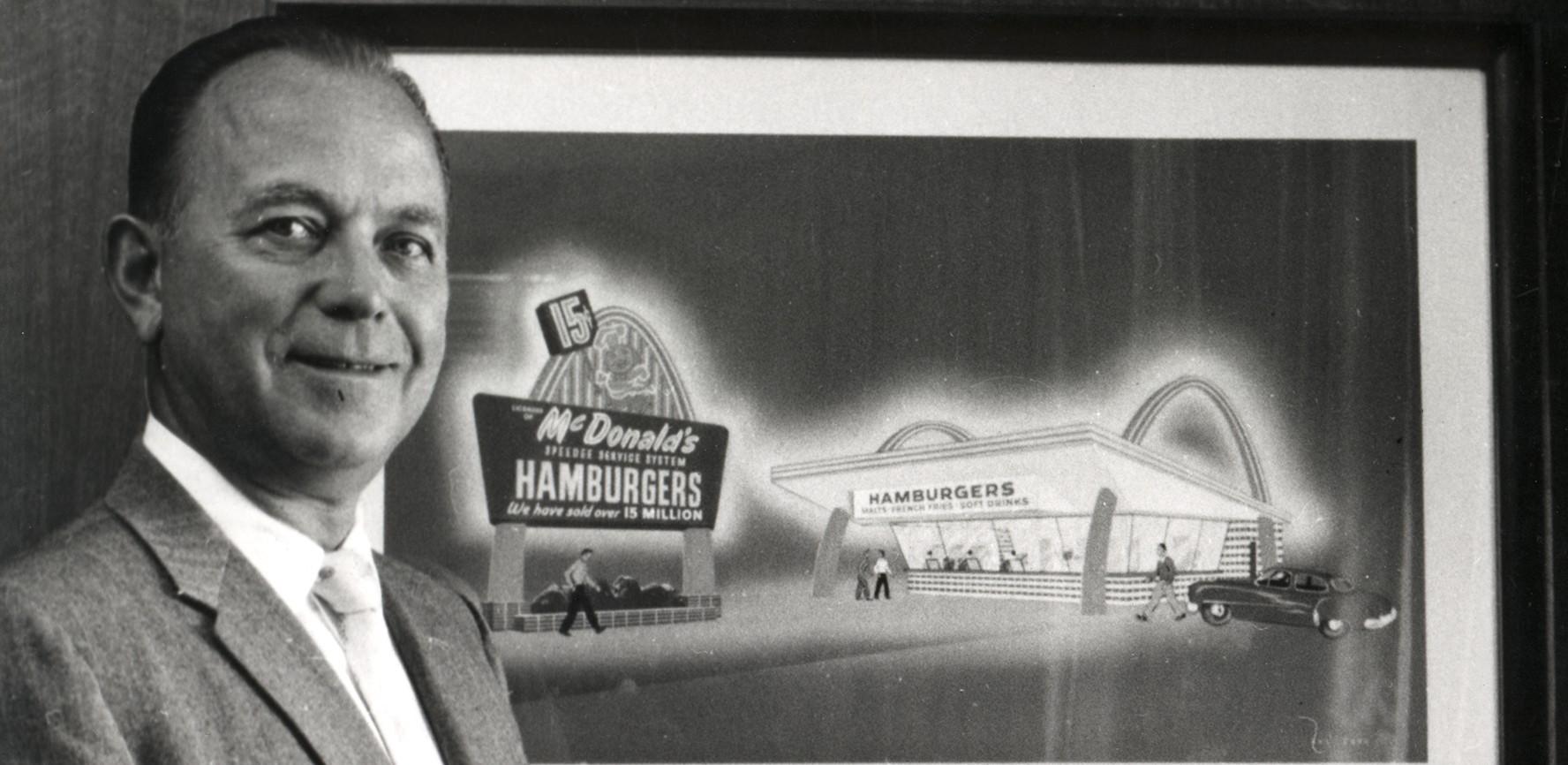
There is a scene in the Ray Kroc biopic, The Founder, in which he is presented with a milkshake made from powder. No ice cream, no freezer, no spoilage, a fraction of the cost — and it tastes just like the real thing. To a modern audience the moment plays as a small tragedy, the first compromise on the road to industrial food. To Kroc and to his McDonald’s customers in mid-century America it was something else entirely: It was a minor miracle. Chemistry had abolished a constraint that had governed food since the beginning of the species. The prevailing sense of awe was manifest in the rhetorical question, ‘What will they think of next?’ Not only were Americans face-to-face with the prospect of ending disease and suffering, so too could they credibly believe that they were close to a kind of utopia where all humans lived amid an unprecedented luxury.
Imagine a young Mexican girl who longed to visit America in the 1960s. She didn’t look forward to the music or the fashion — what she thrilled at was sitting down for lunch with a sandwich made of smooth peanut butter and Wonder Bread — white, fluffy, uniform, pre-sliced, and still fresh on the fourth day. It is common now to treat that loaf as a symbol of everything hollow about mid-century America. Consider instead what it actually represented to a girl who lived on bread that went hard and started to mold overnight. And consider a fact almost nobody remembers: Beginning in 1941, American commercial bread was enriched with B vitamins and iron by federal standard, as a wartime public-health measure — and pellagra, a disease that had killed and maddened tens of thousands of Americans within living memory, essentially vanished from the country. The white fluffy loaf was a public health intervention that worked so completely that it had erased the memory of the problem it solved.
That is the texture of the stasis. Not a slogan about progress, but a thousand daily demonstrations that the men in the white coats were right — that when they said a thing would work, it worked, and life got measurably easier. It was an age, aptly titled the ‘Wonder Years’ by a nostalgic show of my childhood, where the question ‘How would we know?’ was on everyone’s minds, confident that they would continue to answer it with little miracles of modern life. Nobody had to be persuaded to trust the institutions. The institutions kept delivering evidence every day.
Of course, none of this should be mistaken for a golden age. The same machinery that built trust with the majority excluded minorities, buried stories, and enforced a consensus narrower than the country it claimed to represent. By the same token, the chemistry that kept the milkshake stable and the bread soft was a chemistry of emulsifiers, preservatives, hydrogenated fats, and synthetic dyes — most of which were later discovered to have done real physical harm to consumers. What appeared to have a shiny delicious facade was underneath a grimy mixture of toxins. The same could be said for the entire system. The gigantic bureaucracy that had been created to advance the liberal custodian order was already corroding the arteries of truth-seeking to the extent that, by mid-century the dissolution was well underway.
The Seeds of Dissolution
Despite the unprecedented level of scientific and technological achievement, it must be said that American knowledge institutions did not arrive at the twentieth century’s epistemological stasis in good health. They met them having spent fifty years quietly replacing verification with proxies for the same reason as all knowledge institutions do — they had succeeded.
Science had always been a dubious business. In 1830 Charles Babbage published Reflections on the Decline of Science in England, an angry catalogue of the ways researchers massage their findings, and he gave the varieties names that have outlived him: hoaxing, forging, trimming, and cooking — the origin of our phrase about cooked books. R. A. Fisher would later find Mendel’s pea ratios suspiciously obedient; Millikan’s notebooks show drops excluded on grounds that appear nowhere in the published paper. The temptation to help the data along is as old as data.
What contained it was not virtue but smallness. Through the nineteenth century a scientific field was a few hundred people who read one another’s papers, corresponded, and met at the same handful of societies. Reputation among that group was simultaneously the enforcement mechanism and very nearly the entire reward, and a claim that failed cost you standing with the only audience you had. That is an extraordinarily effective filter. It is also one that cannot survive growth, because it depends on everyone knowing everyone.
But success begets demand. And Vannevar Bush’s 1945 report to the president, Science: The Endless Frontier, built the federal grant state on the argument — vindicated by radar and penicillin and the bomb — that publicly funded basic research pays for itself many times over. It was right, and it worked, and it transformed a guild of thousands into a profession of millions. The phrase ‘publish or perish’ appears in the literature of academic life by 1942 and describes the world that followed. Once a community grows past the point where anyone can know anyone, personal reputation can no longer do the filtering, and something must be found to replace it.
What replaced it was counting. In 1964 Eugene Garfield launched the Science Citation Index, and with it the journal impact factor — conceived as a tool to help librarians decide which subscriptions to buy. Within a generation it was being used to evaluate individual scientists, a use Garfield himself warned against repeatedly and unavailingly. The change this represents is easy to understate: Evaluation shifted from quality, assessed by peers who read your work and formed an opinion of it, to quantity, assessed by deans, committees, and funders who gauge a career without examining its contents. And the moment a scientist can be evaluated by people who never read the work, the reward detaches from whether the claim is true and attaches to whether the claim is shared.
Two laws describe what happens next, and both were formulated in the same decade the machinery was being installed. Goodhart’s, as later sharpened by the anthropologist Marilyn Strathern: When a measure becomes a target, it ceases to be a good measure. And Campbell’s, stated by the psychologist Donald Campbell in 1976: The more a quantitative indicator is used to make social decisions, the more it will distort and corrupt the processes it was meant to monitor. Add a binary gate — Fisher had offered p < .05 in 1925 as a rough rule of thumb for whether a result deserved a second look, and the textbooks converted it into a publication threshold — and the system acquires a number that can be manufactured. Add the post-1970s collapse in the ratio of permanent positions to doctorates awarded, and mass production of work becomes a condition of survival. None of this requires a single dishonest person. It requires only that everyone respond rationally to what is being incentivized.
But the grant state did not only change how many scientists there were. It changed, quietly and permanently, what science is. Before 1940 a researcher’s questions were set mainly by curiosity, by his discipline’s open problems, and by whatever patron or university he had persuaded. Afterward they were set, increasingly, by what a federal panel would fund — and a panel is a committee, subject to every pressure committees are subject to. Fashionable fields grew and unfashionable ones starved regardless of merit. Proposals had to promise results, which selects against genuinely uncertain work and for the safe increment; the grant cycle imposed a three-year horizon on questions that might take twenty. Whole areas migrated toward whatever could be framed as bearing on national priorities, because that was where the money was, and researchers are not fools. And the review panels themselves were staffed by the established figures of each field, which means the system acquired a structural bias toward extending existing paradigms and against the outsider with an unwelcome idea — the very person on whom the history of science disproportionately depends.
Eisenhower saw this clearly and said so in the same 1961 farewell address that gave us the phrase ‘military-industrial complex’, warning in the very next breath that a government contract had become a substitute for intellectual curiosity, and that public policy could itself become the captive of a scientific and technological elite. It is the least quoted half of the most quoted speech of the century, and it describes just how an epistemological stasis dissolves: not by corruption per se, but the redirection of an entire truth-seeking enterprise by the structure of its funding.
The Auditor Within the Audited
The press underwent its own version of the same story, on the same timetable, and its case is the most consequential of all — because in the design of the liberal order the press is not merely one institution among others. It is the audit channel: the single component built specifically to sit outside the government and check it. When an audit channel drifts, nothing catches the drift, because it was the thing that caught things.
Journalism’s professionalization was a genuine achievement. The sourcing standards, the corrections policies, and the ethics codes were built to solve the real problems of the yellow-press era, and they worked. But notice where the central norm came from. Objectivity was not handed down from philosophy; it arrived substantially through economics. The wire services had to sell the same copy to papers of every political stripe, which made neutrality a commercial necessity before it was an ethical one. Broadcast licensing then made it a regulatory one. What emerged was a norm that was genuinely valuable and also, in practice, something narrower than it sounded.
Because objectivity in daily practice became proceduralism: Report what officials said, attribute it accurately, balance it against what other officials said. That is checkable, defensible, and teachable — and it quietly redefines news as the sayings of officials. Which means the audit channel took its agenda, its calendar, and its raw material from the very institutions it was supposed to audit. Access became the working currency, and access is a proxy exactly like citation count: proximity to power standing in for knowledge of the truth, and detaching from it the moment that maintaining proximity requires not printing certain things.
The extreme specimen is almost too perfect to be true. In March 1945 General Leslie Groves came to the offices of The New York Times and secretly recruited its lead science reporter, William L. Laurence, to write press releases for the Manhattan Project. Laurence stayed on the Times payroll while the Army covered his expenses. He helped draft the public statements on the bomb for President Truman and Secretary of War Stimson. He was the only journalist to witness the Trinity test and the bombing of Nagasaki, and he coined the phrase “Atomic Age.” The Times did not disclose his dual employment until the day after Hiroshima, four months in.
Then, when the Australian reporter Wilfred Burchett reached Hiroshima independently and filed the first Western account of radiation sickness, the War Department flew a group of correspondents to New Mexico to rebut him — and Laurence delivered. His front-page story of September 12, 1945 ran under the headline “U.S. Atom Bomb Site Belies Tokyo Tales”, reporting that blast and not radiation had done the killing. Burchett’s accreditation was withdrawn. Laurence won the Pulitzer Prize.
Hold the whole shape of that in view. An independent reporter told the truth. The establishment press, literally on the government payroll, told the country he was repeating enemy propaganda. And no correction came, because there was no second channel through which one could arrive. That is what a monopoly audit channel does when it is captured: It does not merely fail to check power. It becomes the instrument by which the check is defeated.
Laurence is an extreme case, but the structural pattern was ordinary. The Times knew of the Bay of Pigs plan in advance and softened its coverage at the administration’s request — after which Kennedy is said to have remarked to the paper’s managing editor that publishing more would have saved him from a colossal mistake. Reporters in Saigon attended daily briefings they privately called the Five O’Clock Follies and filed the official numbers anyway, for years, before the credibility gap became a national story. And the Tuskegee syphilis study was never in any meaningful sense a secret: It was written up in medical journals for four decades, available to anyone who cared to look. No journalist looked until 1972.
Journalists and publishers, in defense of themselves, cite several cases as proof that the audit did function. Murrow took on McCarthy; the Times and the Post published the Pentagon Papers over the government’s objection; two young reporters brought down a president. But, even if they are what the professionals say they are, they are unquestionably the exception, not the rule. Each story is celebrated precisely because it was exceptional — the audit working as an act of individual courage rather than as a structural property of the system. A check that depends on heroism is not a check. It is a hope.
And so, despite the apparent stasis and the confidence of the average citizen that the American century had gained, almost the entire criteria layer had been hollowed out — vulnerable, in every case, because of its own success.
This is part of a series of essays that examine the current epistemological crisis.
PART I: The Fauci Affair and Our Epistemological Crisis
PART II: A Theory of Epistemological Stasis and Crisis
PART III: How We Got Here: The Hollow Stasis