
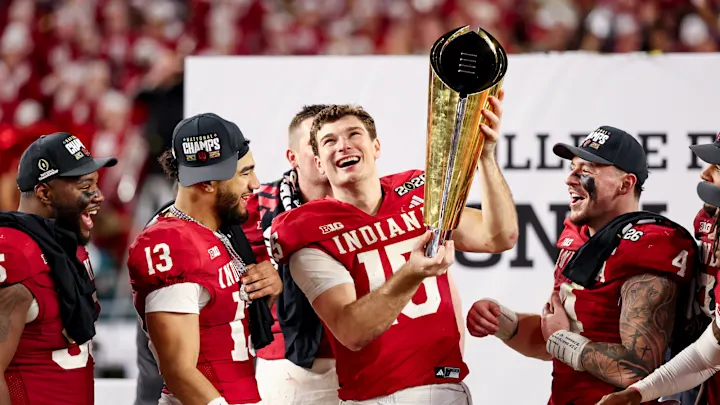
Were the 2025 Indiana Hoosiers the Greatest College Football Team Ever?
From the book Never Daunted: How Curt Cignetti Took Indiana Football from Worst to First and Changed the Game.
In the hours and days after the 2026 College Football National Championship game, the world did what it always does when something unprecedented happens: It rushed to categorize, to make sense, to figure out. Panels convened. Lists were dusted off. Graphics were built. The question came fast and loud—is this the greatest college football team of all time?
The usual titans were invoked. 2019 LSU, with Joe Burrow’s video-game offense and a parade of future NFL stars. 2020 Alabama, Saban’s final masterpiece, relentless and ruthlessly efficient. 2001 Miami, perhaps the most talent-dense roster the sport has ever seen. 1995 and 1975 Nebraska teams that overwhelmed opponents with size, speed, and inevitability. These teams shared common traits: generational talent, eye-popping scoring ability, and rosters that doubled as NFL depth charts.
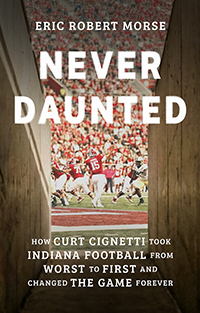
Buy now: Paperback | Kindle
On paper, Indiana didn’t quite reach those levels. Though the Hoosiers’ club attained only the second 16-0 season ever and the first since Yale did it in 1894, there’s no saying that LSU or Alabama would not have won 16 games if their schedules had allowed for it. At the same time, the Hoosiers’ statistics didn’t scream the way LSU’s did. They didn’t simply vaporize every opponent from kickoff to final whistle, though they had their fair share of vaporizations. Their offense was elite but not mythic; their defense dominant but not built on household names. Their social-media-friendly numbers—raw yardage totals, viral highlights—rarely told the full story. What did stand out were the quieter metrics: point differential, takeaways, penalty discipline, third-down efficiency, and, most of all, wins in close games. Indiana was challenged. They were bloodied. They were knocked behind the chains, put on the ropes, and forced into uncomfortable moments, with all credit going to formidable opponents like Oregon, Penn State, Ohio State, and Miami. But every time, Indiana responded. And that, if anything, is what set the Hoosiers apart.
In an interview after the championship game, stand-out Bengals wide receiver Ja’marr Chase was asked who would win if his 2019 LSU Tigers were to play these 2025 Hoosiers, and he didn’t mince words. “Bro, there’s no chance. Bro, there’s no chance,” he repeated, almost in disbelief that it was even a question. “It was 22, damn near the whole starters went to the league,” Chase said. “That’s what I’m saying.”
On its face, the argument is airtight. The 2019 LSU roster was a generational concentration of ability. Burrow, Chase, Jefferson, Edwards-Helaire—elite talent stacked upon elite talent, deployed in an offense that redefined spacing and pace. As Chase pointed out, a slew of defensive players also made the jump to the League. If football were a simple aggregation of individual ceilings, the case would be closed before kickoff. It would be impossible to beat them.
But that exact logic had followed Indiana for an entire season—and it had been wrong every single time.
Oregon had more talent. Penn State had more talent. Ohio State had more talent. Alabama had more talent. Miami had more talent. In each case, the pregame conversation centered on the same premise: eventually, Indiana would be exposed by a roster that simply had more dudes. And yet, Indiana kept winning—not by avoiding those teams’ strengths, but by absorbing them. By forcing games into spaces where talent alone was insufficient.
That’s where the comparison breaks down—not at the level of ability, but at the level of structure.
Chase, like pretty much everyone else in the sport, was operating on the conventional wisdom of what makes a successful football team. The thought is that if you pile up enough talent, you will win. The more talent, the more winning.
But throughout the 2025 season and post-season, Indiana proved this conventional wisdom to be wrong again and again. They consistently faced teams with more talent on paper, and the pundits all said that Indiana would be crushed. And each time the pundits were badly mistaken.
The uncomfortable fact that Chase and others couldn’t come to terms with is that talent doesn’t guarantee success. It never has. History is crowded with teams that were faster, stronger, and more gifted than their opponents—and still lost because talent without discipline frays under pressure. Talent without a system improvises. Talent without shared standards relies on heroics. And heroics, by definition, are unreliable.
Indiana was the opposite. The Hoosiers were not a collection of pieces but a functioning whole. Every snap looked like the first snap or last snap because every snap was governed by the same rules. They did not play differently when ahead or behind, against elite teams or overmatched ones. They didn’t chase outcomes; they executed processes. The result was a brand of football that was brutally dependable. It was fundamentals football elevated to an art form.
The question is not whether LSU had better players—it’s whether LSU, or any team, could impose its will on a system that could bend but never break. Indiana’s advantage was not explosiveness but inevitability. They shortened games without playing slow. They forced errors without gambling. They punished mistakes without overreaching. They won because they were never sloppy when opponents needed them to be.
Whole over pieces. System over parts.
That doesn’t mean talent is irrelevant—it means talent must be harnessed. And Indiana proved something unsettling to the sport’s hierarchy: a team with mostly zero-, one-, and two-star players, if trained to a ruthless standard and unified by belief, can neutralize superior ability long enough to win the game. Not once. Every time.
So would Indiana beat 2019 LSU? Of course, that question can’t be answered definitively. Hypotheticals don’t play four quarters. But the insistence that it would be an impossibility rests on an assumption the 2025 Hoosiers systematically dismantled—the assumption that raw talent invariably overwhelms discipline.
Indiana existed as living counter-evidence. And once that evidence accumulates enough times, it stops being a fluke and starts becoming a principle.
The Hoosiers didn’t go 16-0 because they were the most gifted team college football had ever seen. They went 16-0 because they were the most complete. And completeness, when it shows up snap after snap, has a way of making impossibilities possible.