The Reign of the Masses: Ortega y Gasset a Hundred Years On
Those attuned to the socio-political currents of our time will find themselves haunted by a perplexing question: Why, in an age of unprecedented material comfort, technological power, and social abundance, are so many turning toward ideologies of grievance, dependence, and State control? We live with more convenience, security, and wealth at our fingertips than any civilization in history — groceries delivered to our door, instant communication, medical miracles, luxuries once reserved for kings. Yet at the same time we’ve seen class and race tensions re-intensify, worker unrest and resentment deepen, and socialism returning to the public imagination with surprising force. While any number of contemporary theorists have admirably attempted to explain the paradox, few if any have quite grasped the entirety of the problem. For the best insights on the issue, it is necessary to go back to a book written nearly a century ago when the trends we see fully blooming now were just beginning to sprout.

In The Revolt of the Masses, Spanish philosopher José Ortega y Gasset foresaw with startling clarity the rise of what he calls the “mass-man” — the self-satisfied child of modern abundance — and showed how the triumphs of liberal civilization would paradoxically create a populace increasingly incapable of sustaining it. As searching as it is insightful, the book reads less like a period piece of interwar Europe and more like a diagnosis of our own age. Written between 1926 and 1929 and published as a book in 1930, it seeks to explain the spiritual condition of modern civilization at the very moment it achieved its greatest material triumphs. Through crisp, aphoristic prose, Ortega offers a penetrating cultural critique: The modern West has created a world of abundance so expansive that it has unintentionally transformed the nature of man himself.
Historical Context and Ortega’s Project
Born in 1883, Ortega lived during the twilight of old Europe, witnessing the collapse of monarchies, the rise of mass politics, and the birth of modern ideologies. Educated in Germany and steeped in phenomenology, liberalism, and classical thought, he wrote The Revolt of the Masses in the aftermath of World War I, amid rapid technological growth and expanding democratic participation. His concern was not with material progress itself, but with its unintended psychological and political consequences.
The book addresses what happens when luxury and ease become the default condition, when society no longer demands heroic effort from its citizens, and when masses of ordinary people — untutored in responsibility — suddenly rule through the sheer gravity of their numbers.
Thesis
Ortega’s thesis is stark: technical advancement has produced a state of unprecedented plenitude in the West, and this abundance has allowed the population to multiply rapidly, filling every sphere of public life with the “mass-man” who benefit from civilization without feeling responsible for maintaining it. Society has grown comfortable, democratic, and materially rich — and in the process, spiritually and culturally impoverished.
From Want to Plenitude
Much of human history, Ortega notes, was defined by scarcity. People lived in want, wrestling resources from nature through labor, discipline, and self-restraint. Modern technology changed all of that. For the first time in history, civilization delivered goods, comforts, and conveniences not to a small aristocracy, but to the average man. It has created a world where lack is the exception rather than the rule — a world of plenitude rather than want.
As Ortega puts it, “The life of the average man to-day is easier, more convenient and safer than that of the most powerful of another age. What difference does it make to him not to be richer than others if the world is richer and furnishes him with magnificent roads, railways, telegraphs, hotels, personal safety and aspirin?”
The Statistical Fact
The key insight of the work rests in the chapter titled ‘The Statistical Fact’, where Ortega explains that the abundance of the modern age has enabled something historically unique: A massive and unprecedented population increase. The demographic expansion of Europe in the 19th and 20th centuries is the statistical fact upon which Ortega builds his argument. There are more people than ever before, living more comfortably than ever before, and they now occupy the positions, institutions, and privileges once reserved for cultivated minorities.
Ortega draws on the work of German economist Werner Sombart. “The fact is this: from the time European history begins in the VIth Century up to the year 1800—that is, through the course of twelve centuries—Europe does not succeed in reaching a total population greater than 180 million inhabitants. Now, from 1800 to 1914—little more than a century—the population of Europe mounts from 180 to 460 millions!”
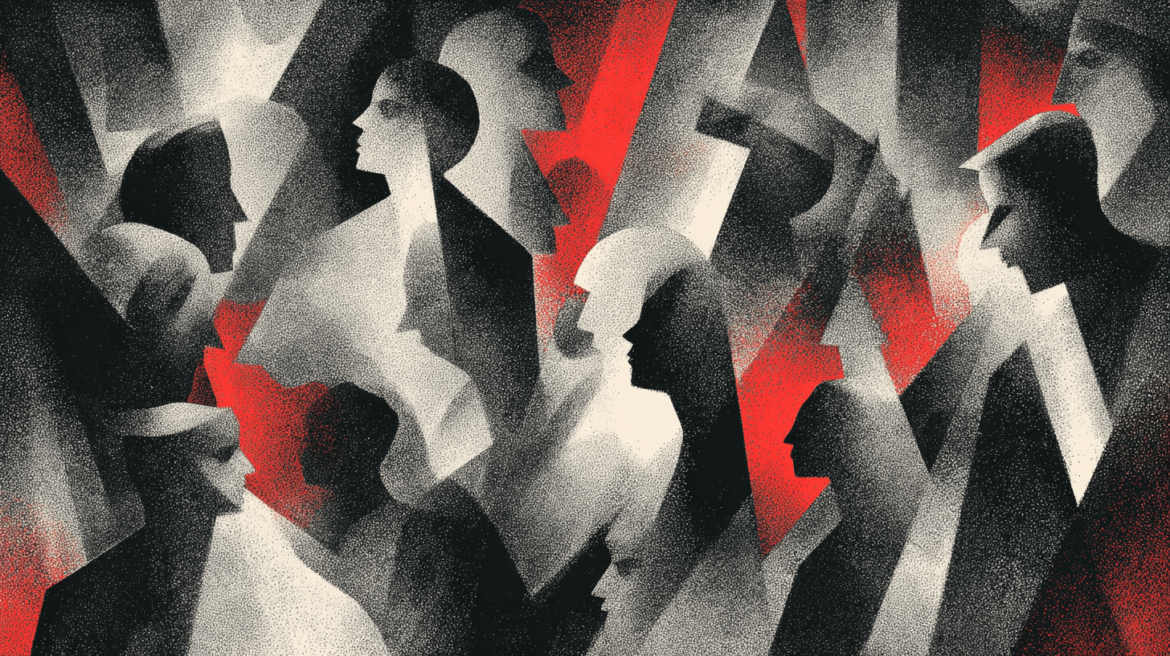
Where once a theater might have held a select audience, Ortega shows how it was now filled to bursting with the general public. In rail stations, boulevards, cafés, and universities, the masses were everywhere — not only present, but dominant. Their tastes came to define culture, their opinions shaped politics, and their expectations became the standard.
To the twenty-first–century reader, accustomed to hour-long commutes, overbooked flights, and long lines at Starbucks, the notion of crowdedness may not feel especially revelatory. Density is simply the air we breathe — the default condition of modern life. But in Ortega’s day, this swelling of the public was nothing less than epoch-making. He witnessed in real time how the sudden appearance of masses in theaters, streets, universities, parliaments altered not only the social order but the interior life of the average person. It was this psychological transformation, not merely the physical presence of more bodies in public space, that constituted the true revolt of the masses.
From Demography to Psychology: The Rise of the Mass-Man
The change is not merely quantitative but qualitative. Quantity has bred a new psychological type: the mass-man.
This figure is not a social class but a mindset. As Ortega writes, the mass-man of today has “two fundamental traits: the free expansion of his vital desires, and therefore, of his personality; and his radical ingratitude towards all that has made possible the ease of his existence.”
As such, according to Ortega, the mass-man bears the psychological traits of a spoiled child: “Heir to an ample and generous past—generous both in ideals and in activities—the new commonalty has been spoiled by the world around it. To spoil means to put no limit on caprice, to give one the impression that everything is permitted to him and that he has no obligations. The young child exposed to this regime has no experience of its own limits.” (My emphasis.) Civilization appears to the mass-man as an automatic mechanism, like tap water: press the lever and the miracle flows. He lacks any consciousness of the generations of effort that made such a world possible.
From this spirit arises a set of recognizable tendencies:
Characteristics of the Mass-Man
- He demands rights and neglects duties.
He believes benefits are natural, but responsibility is optional. - He rejects self-discipline and higher aspiration.
Why strive, when comfort already exists? - He places supreme confidence in his own opinions.
Expertise is dismissed; technical or learned authority is resented. Every opinion is considered equal by default. - He intervenes in public life not through reasoned argument but through pressure, force, and emotional dominance.
Debate gives way to coercion — in the mind of the mass-man, might makes right.
The result is a paradoxical figure: Materially advanced, spiritually primitive. In him, Ortega sees the flowering of what Nietzsche warned in the last man — the one who would rather blink comfortably than risk greatness.
Consequences of the Mass-Man
The rise of the mass-man carries three major cultural dangers:
1. Primitivism
Despite living among the highest fruits of civilization, modern man becomes primitive — not because he returns to simplicity, but because he forgets history. Without memory of how civilization was built, he loses the virtues that sustain it: reverence, gratitude, and sacrifice. He is technically modern but spiritually Neolithic.
2. Barbarism of Specialization
Ortega warns of what could be called the ‘learned barbarian’: the specialist who knows much about one narrow field but lacks cultural breadth, philosophical reflection, or humility. He is brilliant as a technician and impoverished as a human being. Science advances while wisdom decays.
3. Socialism and Statism
Finally, the masses seek a State that provides everything — bread, leisure, security — without the duties of citizenship. The State expands endlessly to satisfy these demands, smothering independent institutions and excellence in the process. Ultimately, civilization risks collapsing under the weight of its own comforts.
The Reign of the Masses
Nearly a century after the book’s publication, Ortega’s warnings read like a social media news feed. Primitivism now appears in the cultural instinct to elevate feeling above fact — the triumph of impulse, outrage, and identity over argument, where public discourse is shaped less by reason than by visceral reaction. The barbarism of specialization is visible in experts who know everything about one narrow domain yet possess no grounding in history, philosophy, or the humanities — technicians brilliant at means but blind to ends, able to build tools but not to justify their use. And socialism/statism, once a fringe ideology in the West, has become fashionable again, with growing calls for state control of healthcare, education, housing, speech, and economy — all advanced not as necessary evils, but as moral imperatives. What Ortega feared — a society guided not by cultivated judgment but by mass desire, enforced through politics — is no longer emerging. It has arrived.
The modern reader is pleased to find that The Revolt of the Masses is not a lament for old aristocracies, nor a rejection of democracy, nor a reactionary defense of privilege. It is a warning that civilization is fragile, that abundance can erode the virtues that created it, and that a society led by spoiled heirs rather than responsible stewards will drift toward barbarism even while surrounded by luxury.
Ortega’s book endures because it captures a permanent tension in democratic life: When everyone has comfort, no one remembers how to sustain it. His mass-man lives among miracles but cannot maintain them. His revolt is not against tyranny, but against excellence.
Nearly a century later, his diagnosis reads not as prophecy fulfilled, but as the world we now inhabit.