
Charlie Kirk and the Catastrophic Fallacy at the Crux of Our Political Divide
While the assassination of Charlie Kirk was devastatingly horrific, it is possible that the response from regular people on the left has been even more appalling. People coyly smirking when asked about it, people saying they have no more empathy for “people like that,” people openly laughing, even celebrating, suggesting that so-and-so should be next. I have been shocked to see this out of seemingly normal people. How in the world could people be so blasé about this — or worse, enthusiastic?
A clue can be found in Ezra Klein’s New York Times essay after the killing. Though Klein disagreed with Kirk on almost every issue, he wrote that “Charlie Kirk was practicing politics the right way.” Through debate, in real life. At first, it looked like a sensible stance from a sensible person on the left. Kirk’s approach is the exactly how a divided nation should disagree. But Klein immediately faced a torrent of rage from his own side. Hard-core leftists shouted him down: Kirk was sexist, homophobic, racist, xenophobic, white-supremicist, and fascist. To even grant him civility, they argued, was appalling. Author Mark Harris, who has 77k followers on Bluesky, summed it up:
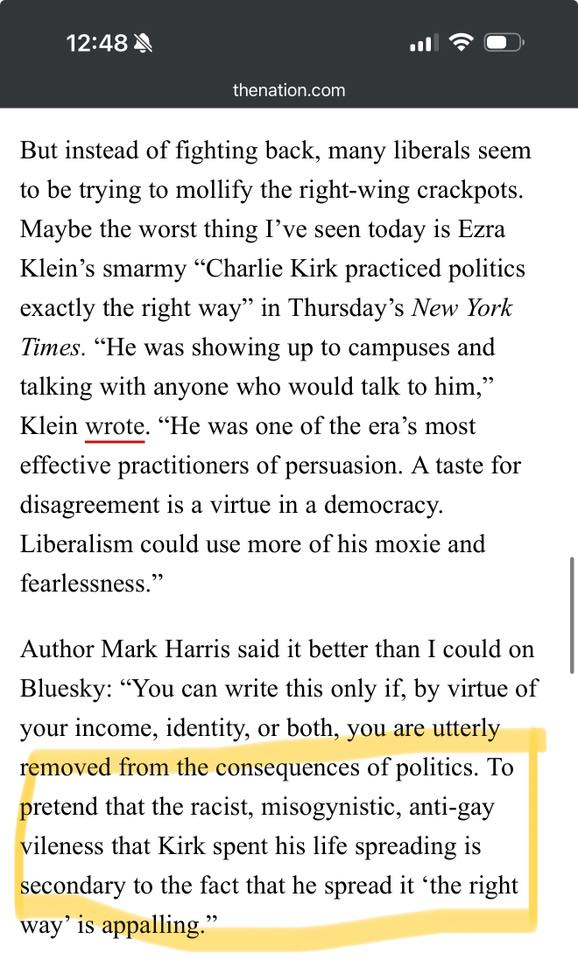
“You can write this only if, by virtue of your income, identity, or both, you are utterly removed from the consequences of politics. To pretend that the racist, misogynistic, anti-gay vileness that Kirk spent his life spreading is secondary to the fact that he spread it ‘the right way’ is appalling.”
The message was unmistakable: Since Kirk was branded with those labels, he was not only unworthy of admiration or pity — he was worthy of the end he received. As the assassin reportedly said in a family conversation prior to the assassination, Kirk was a “symbol of hate,” and therefore had to be killed.
This rationale might seem straightforward to those on the left. The rest of us are left absolutely horrified by it. Even if Kirk was all of those things — and he demonstrably was not — how could so many conclude that it would justify the death penalty? How could having a bad opinion be the reason for someone’s death?
The answer lies in a fallacy that has taken deep root in modern thought, especially on the left of the political divide: The belief that words are violence.
The Intellectual Roots
The problem begins in linguistics, but its origins trace back through ideology. Antonio Gramsci in the 1920s emphasized that culture and language shape “hegemony.” If language controls thought, then revolution requires controlling language, a principle later instituted by Stalin in the Soviet Union. Herbert Marcuse, in his 1965 essay Repressive Tolerance, went further: Tolerating “harmful” speech entrenches oppression. Therefore, silencing certain viewpoints could be reframed as liberation.
Legal shifts reinforced the point. The “fighting words” doctrine and harassment law in the 1960s introduced the idea that certain speech acts operate like conduct, not expression. Feminist theorist Catharine MacKinnon later argued in Only Words that pornography itself was a form of subordination, a kind of violence against women rather than a form of artistic expression. This paved the way for all manner of speech to be deemed oppressive and violent. By the 1970s and 80s, Critical Theory had been applied to race and expanded the fallacy. In Critical Race Theory: An Introduction, Richard Delgado and Jean Stefanic claimed that racial stereotypes and slurs are not simply offensive but forms of structural violence.
The Canceling of the American Mind
Thus the ground was prepared for the cultural revolution of the last twenty years. If words equal violence, it is the job of the government to protect people from harmful words. It was most evident in the university. The now classic Coddling of the American Mind by Greg Lukianoff and Jonathan Haidt chronicle this well: Starting around 2010, trigger warnings and safe spaces proliferated on college campuses. Media outlets published serious debates on whether “speech is violence.” Social media mobs justified cancel campaigns as a defense against the trauma of conservative speakers visiting the campus and administrators sending emails that made the students feel “unsafe”.
The psychological sciences seemed to provide scientific backing for this argument. PTSD research showed that reminders and triggers could reproduce trauma. Neuroscientists discovered that brain regions activated by physical pain also activate under social rejection. Scholars of microaggressions insisted that small daily slights can accumulate into psychological injury. Activists added a moral claim: Lack of affirmation, especially for marginalized identities, can be deadly. Disagreement equals rejection; rejection equals harm; harm equals violence.
As Greg Lukianoff and Rikki Schlott recount in their Canceling of the American Mind, “16% of professors say they were threatened or investigated for their speech, and there have been more than 1,000 cancellation attempts since 2014. Of these nearly 2/3 of these resulted in the professors getting sanctioned and 1/5 losing their jobs. That means that more professors have been terminated in the era of canceled culture than in the era of McCarthyism.”
Laws in Europe and Canada codified “hate speech” as a category of social harm akin to violence. Meanwhile, in America, workplace regulations treated verbal conduct as actionable when it created a “hostile environment.”
In development psychology, it is plain to see that the words = violence dogma produces fragility. Students demand safe spaces not to protect them from bombs or knives, but from books and debates, and so cut themselves off from the only source to learn and grow. Activists conflate disagreement with genocide. Social media thrives on weaponized victimhood, where the prize goes to whoever can claim the deepest injury.
In politics, the logic justifies silencing opponents. If speech is violence, then censorship is self-defense. If free expression is hate, then punching, de-platforming, even killing, becomes protection of the vulnerable.
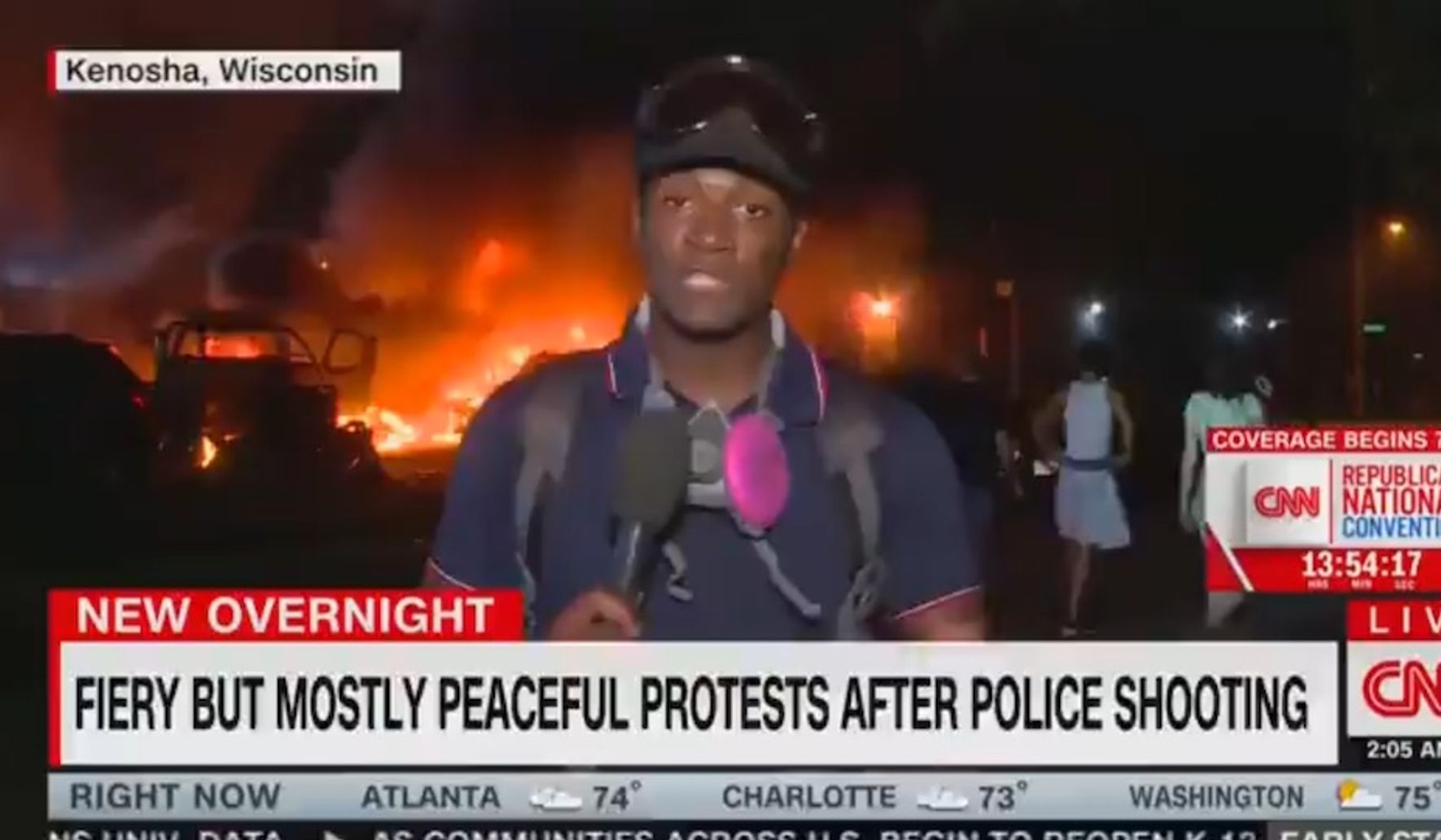
What’s most interesting is that, as words become violence, real violence has been redefined away. Rioters smashing storefronts? Not violence, because property “can be replaced,” or so said Nichole Hannah Jones of the 1619 Project. This is the twisted syllogism of our age: Debating your opponent is violence, but burning his livelihood is not.
This is the ethic that Gramsci and Marcuse and all the other leftist intelligentsia worked to arrive at: Words are violence, so if you disagree, I can destroy you and claim self-defense.
The Case of Charlie Kirk
When Kirk was killed, a bot-like defense flooded the discourse: All kinds of leftists started posting Kirk’s quote, “I think it’s worth it to have a cost of, unfortunately, some gun deaths every single year so that we can have the Second Amendment to protect our other God-given rights.” The snarky retort was ‘Live by the sword, die by the sword’.
But Kirk did not live by the sword. Advocating for gun rights is not shooting them off. Kirk’s entire approach was dialectic. He toured campuses precisely to debate, to connect, to defuse hostility. This is the opposite of living by the sword.
In one exchange, when asked why he bothered, Kirk replied:
“When people stop talking, really bad stuff starts. When marriages stop talking, divorce happens. When churches stop talking they fall apart. When civilizations stop talking, civil war ensues. When you stop having a human connection with someone you disagree with, it becomes a lot easier to want to commit violence against that group…. What we as a culture have to get back to is being able to have reasonable disagreement where violence is not an option.”
Those were his words. That was his philosophy. And that was his approach. And yet many insisted he “lived by the sword.” Why? Because they had so thoroughly absorbed the doctrine that words are violence that they could not distinguish debate from attack. To them, Kirk’s very presence on campus was an assault and demanded some form of violent defense.
Conclusion: Why We Must Reject the Fallacy
The assassination of Charlie Kirk revealed more than the depravity of one man with a gun. It revealed the deep corruption of a language and the social fabric that is based upon it. The ‘words are violence’ fallacy has marched through the institutions from Marxist theory to feminist jurisprudence, from trauma psychology to social media mobs, until it has become dogma on the left.
As such, the ‘words are violence’ fallacy has caused more delusion, paranoia, and fear than any other political ideology of our time. And, as we are now witnessing, it is causing violence.
But it is a lie. It is a dangerous lie. And if we do not reject it — firmly, unapologetically, in every form — then the consequence will not be imaginary harm, but real harm. Not symbolic violence, but civil war. Words are not violence. Violence is violence. And if we lose sight of that distinction, the republic itself cannot stand.
Shortly after the assassination, Kirk’s widow gave a speech, saying that his Turning Point USA would continue on. In response, some seemingly ‘normal’ lady posted a picture of Mrs. Kirk with the caption ‘She’s as hateful as her husband’ almost as if to move the target to her. In any sensible arena of debate, the post might not be so chillingly frightening. But in this milieu, the implications cannot be ignored. Saying that someone is hateful these days has become hate speech in itself and an incitement to violence. The image has over 120k likes at the time of this publication.